
A friend replies with one line: “tf?” No emoji, no explanation. Are they laughing, confused, or actually annoyed?
That’s the tricky thing about TF. Two letters can carry a lot of feeling. This guide explains the TF meaning in text, the rare alternate meanings, real chat examples, and when to use it or skip it.”
🧠 What Does TF Mean in Text?
TF stands for “the f*.”** It’s an informal internet abbreviation that adds emphasis or shows shock, confusion, frustration, or disbelief. It usually sits inside a question, like “what tf is that?”
✔️ Main Meaning:
- Full form: the f***
- Type: informal slang (censored profanity)
- Feeling: surprise, confusion, annoyance, disbelief
- Usual spot: right after a question word (what, why, how, who, where)
Think of TF as a volume knob for a sentence. “Why is the wifi down?” is a plain question. “Why tf is the wifi down?” tells the reader you’re stressed or fed up. The words stay the same, but the feeling gets louder.
The roots go back further than most people expect. “The f***” began in the early 1900s as a blunter version of “the hell,” WTF was already in use by 1985, and the shortened TF became common online in the 2000s. Dictionary.com
📌 Other Meanings of TF in Text
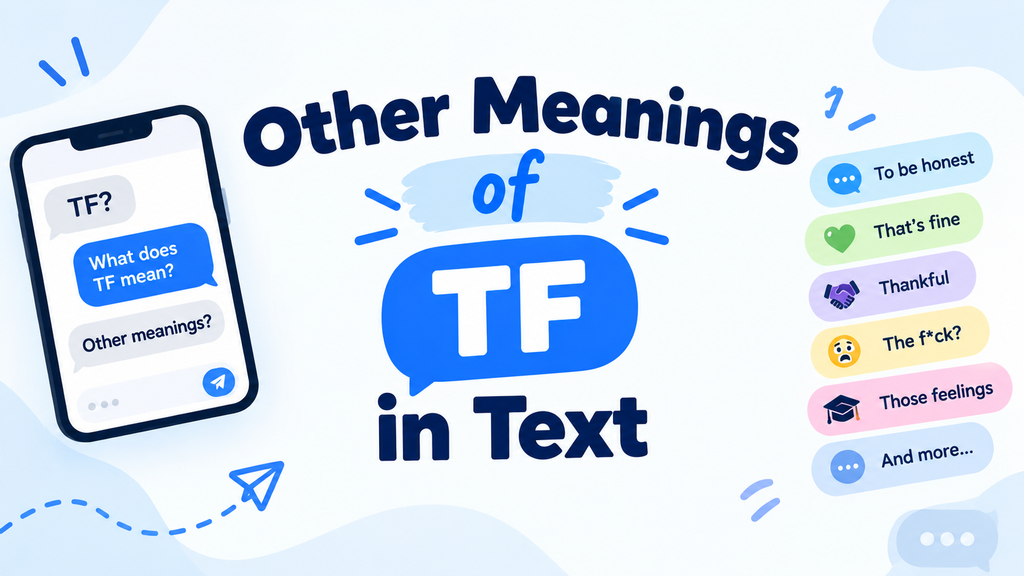
In everyday texting, TF means “the f***” nearly every time. A couple of other readings do turn up, mostly in captions, comments, and gaming chats.
🌟 1. That Feeling
A few slang guides list TF as “that feeling,” used in relatable or emotional posts. In practice, most people type TFW (“that feeling when”) for this. If you see a lone “tf” under a cozy or nostalgic post with a soft emoji, this may be what they meant. Meaningspots
Example: “Rain outside, tea in hand, zero plans. tf 😌”
😂 2. Too Funny
Slang.net lists TF as “too funny,” a quick way to say something cracked you up. You’ll spot it beside laughing emojis. It’s uncommon, though. Without 😂 or 💀, assume the swear-word meaning. Slang.net
Example: “That dog-in-sunglasses video is tf 😂”
✔️ Summary:
| Meaning | How common | Clue to look for |
|---|---|---|
| The f*** | Very common | Follows what, why, how, who, where |
| That feeling | Rare | Soft or nostalgic caption (TFW is more usual) |
| Too funny | Rare | Laughing emojis |
| Team Fortress / task force | Niche | Gaming servers or official documents |
Dictionaries also list TF as “task force,” and gamers know TF2 as Team Fortress 2. Rule of thumb: in a normal chat with no laughing emoji, it’s the swear-word version. Merriam-WebsterWikipedia
📱 Where Is TF Commonly Used?
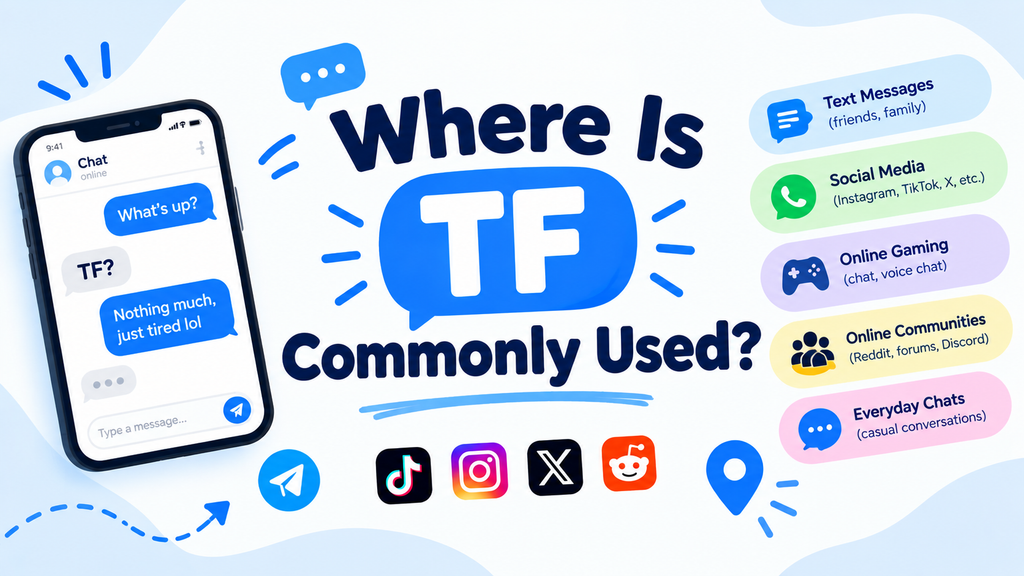
TF lives anywhere people type fast and react faster.
📍 Popular Platforms:
- Snapchat, iMessage, WhatsApp: quick private reactions
- TikTok and Instagram: comments, captions, and reel replies
- Discord and gaming chats: reacting to plays, glitches, and lag
- X (Twitter) and Reddit: replies, threads, and memes
- Group chats: friends and siblings, where the tone is relaxed
🧩 Tone & Style:
- Lowercase “tf” is the norm. Capitals can signal louder emotion.
- It usually appears mid-sentence: “how tf did that work?”
- It can also stand alone as a reaction: “tf??”
- Emojis set the mood. 😭 or 💀 usually mean playful. A bare “tf.” feels colder.
- Teens and young adults use it most, though many older people recognize it too.
💬 Examples of TF in Conversation
😲 Shock (The F*** Meaning)
Maya: Look outside. The sky is completely orange.
Leo: tf?? Is that smoke?
🤔 Confusion
Sam: Meet me by the blue building.
Ari: What tf are you talking about? They’re all blue.
😂 Too Funny Meaning
Nina: (sends a video of a cat riding a robot vacuum)
Jo: tf 😂😂 I can’t
😌 That Feeling Meaning
Caption: Golden hour, quiet street, one song on repeat. tf 😌
😤 Frustration
Dev: Why tf did my phone die at 30%?
😵 Disbelief
Rae: They raised the price again.
Kim: tf… for a sandwich?
😎 Meme Reaction
Post: Me watching a $9 coffee get handed over.
Comment: tf is in that cup, gold? 💀
🕓 When to Use and When Not to Use TF
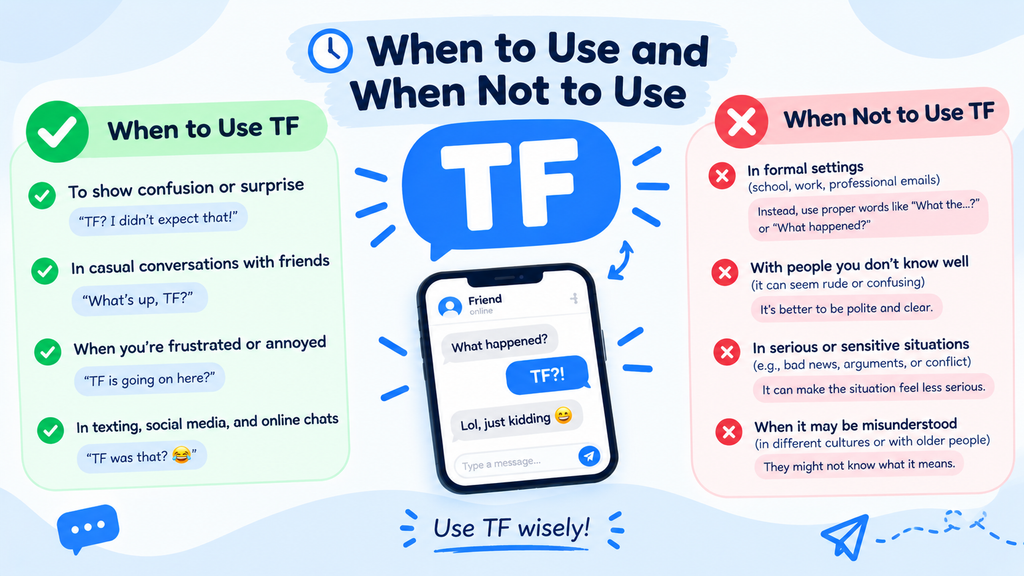
✅ When to Use TF
- Texting close friends who swear casually
- Reacting to memes, videos, or wild news
- Group chats and gaming servers with a relaxed tone
- Adding punch to a question when you’re already in casual mode
❌ When Not to Use TF
- Work emails, Slack messages to managers, or client chats
- School emails and academic writing
- Talking with teachers, older relatives, or people you barely know
- Serious moments like grief, conflict, or bad news
- Professional profiles such as LinkedIn
Quick test: if you’d hesitate to say the full phrase out loud, don’t type TF.
🔄 Similar Slang Words or Alternatives
Want the same energy with less heat? These swaps work well:
- “the heck” / “the hell”: the classic milder swap (“what the heck is that?”)
- “what in the world”: polite and easy to read
- “wait, what?”: neutral confusion
- “seriously?”: neutral disbelief
- FFS: “for f***’s sake,” which is stronger than TF
- “dafuq”: a jokey, exaggerated spelling of the same idea
🧾 Why People Use TF in Texting
⚡ Fast Expression
Two letters beat four words on a phone keyboard. When a reaction hits, people type first and polish never.
😎 Strong Emotion
TF lets you show feeling without explaining it. The reader hears your tone in two letters.
📱 Social Media Culture
Comments, memes, and short videos reward fast reactions. TF fits that rhythm, and it’s now part of everyday internet language.
😂 Flexible Meaning
The same letters can sound shocked, annoyed, amazed, or amused. Context does the rest, which is why people keep reaching for it.
🧠 Is TF Rude or Casual?
It depends on who’s reading and how it’s aimed.
😊 Casual Use:
Among friends, in memes, or in jokes, TF is usually harmless. It’s often just a friendly exclamation.
😐 Neutral Use:
When it’s aimed at a thing rather than a person (“why tf is this app crashing?”), it reads as mild venting. Most people won’t blink.
😡 Strong Use:
Aimed at someone during an argument (“who tf do you think you are?”), especially in caps or with stacked question marks, it reads as hostile. Tone and relationship decide everything.
📊 TF vs Other Reaction Slang
| Slang | Stands for | Strength | How it’s used |
|---|---|---|---|
| TF | the f*** | Medium | Slotted into a sentence: “why tf…” |
| WTF | what the f*** | Medium to high | A full reaction on its own |
| WTH | what the heck/hell | Low | Safer for mixed company |
| SMH | shaking my head | Low | Disappointment, not shock |
| OMG | oh my god | Low to medium | Surprise, good or bad |
| TFW | that feeling when | Low | Relatable moments |
| Bruh | bro | Low | Casual disbelief |
The main difference from WTF is placement. WTF works alone (“WTF!”), while TF usually needs surrounding words (“TF happened?”).
❓ Frequently Asked Questions
❓ What does TF stand for in texting?
TF stands for “the f***.” It adds emphasis or shows shock, confusion, or frustration.
❓ Can TF mean “That Feeling”?
Rarely. “That feeling” is normally written TFW, so check the context and emojis.
❓ Can TF mean “Too Funny”?
Occasionally, usually next to laughing emojis. Without them, it almost always means “the f***.”
❓ Is TF the same as WTF?
Close, but not identical. WTF is a complete reaction, while TF is usually slotted into a sentence and often feels a bit lighter.
❓ Is TF offensive?
It can be, since it stands for a swear word. It’s fine with close friends but risky with strangers, elders, or in serious conversations.
❓ Can I use TF in formal communication?
No. Keep it out of work emails, school writing, and professional messages.
🧾 Final Thoughts
TF is one of those tiny abbreviations that does a lot of work. Most of the time it means “the f***,” and it adds surprise, confusion, or frustration to a sentence. The rare readings, “that feeling” and “too funny,” only make sense with the right context.
Read the tone, check the emojis, and think about who’s on the other end. Use TF with friends and skip it at work. And if someone sends you a mystery “tf?”, a quick “what do you mean?” clears it up.
