If you’ve scrolled TikTok, played online games, or read a group chat lately, you’ve seen it: “That’s cap.” Or maybe the blue 🧢 emoji dropped in a comment section with no explanation at all.
Here’s the short version: in slang, cap means a lie. That’s it. Everything else is just flavor.
This guide breaks down the cap meaning, where it came from, how to use it without sounding awkward, and when to leave it out of your vocabulary entirely.
🧠 What Does Cap Mean in Slang?
Cap is slang for a lie, a false claim, or an exaggeration. When someone says “that’s cap,” they’re saying “that’s not true.”
The word works as a noun, a verb, and a one-word reaction:
- Noun: “That’s cap.” (That’s a lie.)
- Verb: “You’re capping.” (You’re lying.)
- Reaction: “Cap.” or just 🧢
The flip side is no cap, which means “no lie” or “I’m serious.” People add it to a statement the way you’d add an exclamation point to a promise.
🧾 Simple Breakdown
| Phrase | Meaning | Example |
|---|---|---|
| Cap | A lie | “That’s cap, you weren’t even there.” |
| No cap | No lie / for real | “This is the best burger in town, no cap.” |
| Capping | Lying or exaggerating | “Stop capping, we saw the receipt.” |
| Capper | Someone who lies often | “He’s a capper, don’t listen.” |
| Big cap | A huge, obvious lie | “You benched 300? Big cap.” |
| All cap | The whole story is false | “That whole story was all cap.” |
| 🧢 emoji | Silent way to call cap | Posted in replies with zero words |
📱 Where Is “Cap” Commonly Used?
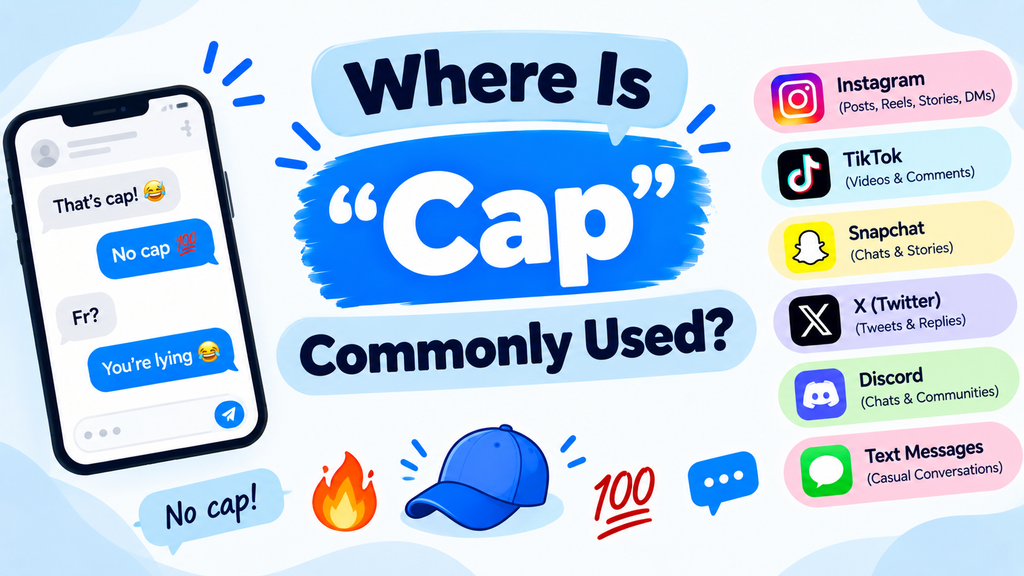
Cap lives online first and spills into real conversation second. It’s short, fast, and works as a complete sentence, which is exactly what comment sections reward.
📍 Popular Platforms
- TikTok: the biggest driver. Comment sections fill with 🧢 under unbelievable videos.
- Instagram: used in captions and replies to stories.
- X (Twitter): quick call-outs on bold claims.
- Discord and gaming chats: aimed at fake stat flexes and made-up wins.
- Snapchat and group texts: casual back-and-forth between friends.
- YouTube comments: under storytime videos and clickbait titles.
🧩 Tone & Style
Cap is informal, playful, and blunt. It’s usually delivered fast, without a follow-up explanation. Most of the time it’s teasing, not accusing. Tone of voice and your relationship with the person do the heavy lifting.
💬 Examples of “Cap” in Conversation
😂 Example 1: Calling out a lie
A: I slept four hours and still hit the gym at 5 a.m.
B: Cap. You were online at 3 a.m.
🙌 Example 2: Being honest
No cap, that was the hardest exam I’ve ever taken.
🤯 Example 3: Exaggeration check
A: There were like 10,000 people at the party.
B: Big cap, it was a living room.
😏 Example 4: Playful conversation
A: I could beat you one-on-one any day.
B: 🧢
🔥 Example 5: Social media caption
First time trying this recipe and it actually worked. No cap. 🍜
🧢 Example 6: Calling nonsense
Stop capping, bro. We literally have the screenshot.
🕓 When to Use and When Not to Use “Cap”
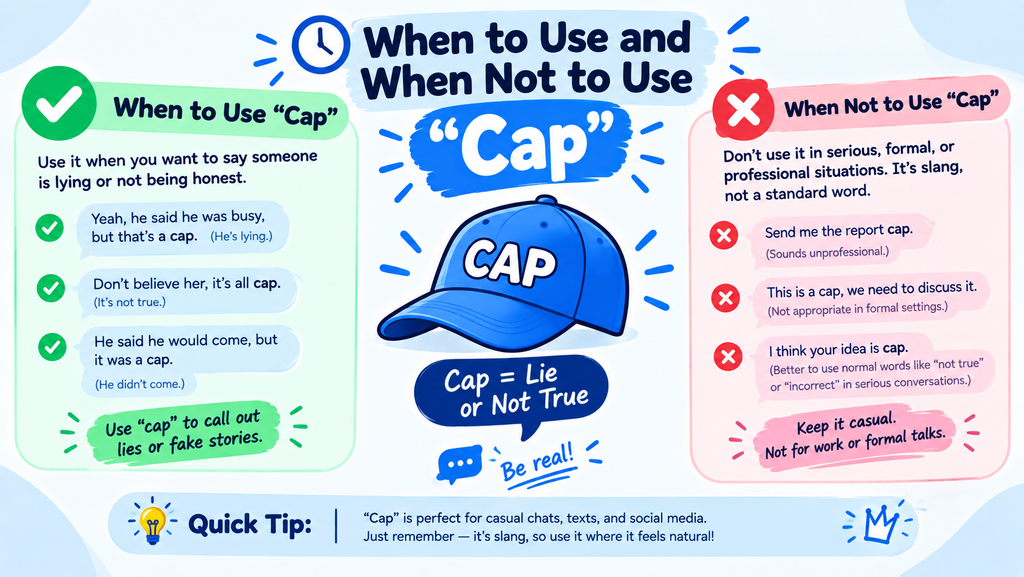
✅ When to Use “Cap”
- Texting friends who already use the word.
- Reacting to an obvious exaggeration in a light, joking way.
- Social captions where you want to sound casual and genuine.
- Gaming and Discord chats, where short reactions are the norm.
- Emphasizing honesty with “no cap” when a claim sounds unbelievable.
❌ When Not to Use “Cap”
- Job interviews, emails, or client messages. It reads as unprofessional.
- Academic or formal writing. Use false, inaccurate, or exaggerated instead.
- Serious disagreements. Calling cap during a real conflict escalates things.
- With people who don’t know the term. You’ll just confuse them.
- When someone is genuinely upset or vulnerable. It minimizes what they’re saying.
🔄 Other Meanings of Cap in Slang
Context matters, because “cap” isn’t always about lying.
| Usage | Meaning | Example |
|---|---|---|
| Slang (Gen Z) | A lie or exaggeration | “That’s cap.” |
| Standard English (noun) | A hat | “He wore a black cap.” |
| Standard English (verb) | To limit something | “They capped the budget.” |
| Gaming | Reaching a maximum level or limit | “I’m level capped.” |
| Finance | Market capitalization | “A large-cap stock.” |
| Older slang | To shoot someone | “Bust a cap.” |
| Dental slang | A gold or cosmetic tooth cover | “He got his teeth capped.” |
If the sentence is about a claim someone made, it’s the slang meaning. If it’s about hats, limits, or money, it isn’t.
🔥 Origin of “Cap” in Slang
Cap isn’t a new TikTok invention. It’s decades old.
The term comes from African American Vernacular English (AAVE). In Black slang, to cap about something means to brag, exaggerate, or lie about it, a meaning that dates back to the early 1900s. By the 1940s, Green’s Dictionary of Slang records “to cap” meaning “to surpass,” linked to the ritualized insult contests known as capping in the 1960s, with both senses rooted in cap as “top” or “upper limit.” dictionarydictionary
The modern spread has a clearer trigger. The phrase “no cap” was popularized by rappers Future and Young Thug on their 2017 track “No Cap.” The expression is closely tied to Atlanta-area hip-hop slang. wiktionarydictionary
From there it moved into memes, then TikTok, then everyday speech worldwide.
Quick timeline:
- Early 1900s: “cap” used in Black communities for bragging or lying
- 1940s to 1960s: “capping” as competitive insult trading
- 2017: Future and Young Thug release “No Cap”
- 2018 to 2020: the 🧢 emoji takes over comment sections
- 2021 onward: fully mainstream Gen Z vocabulary
🔄 Similar Slang Words or Alternatives
| Slang term | Meaning | Closest to |
|---|---|---|
| Cap | A lie | Base term |
| Capping | Lying | Cap (verb form) |
| Fr / for real | Genuinely, truthfully | No cap |
| Deadass | Completely serious | No cap |
| On God | I swear it’s true | No cap |
| Facts | That’s correct | Opposite of cap |
| Bussin’ | Really good | Unrelated but same circles |
| Sus | Suspicious, questionable | Softer than cap |
| Bluffing | Faking confidence | Cap |
If you want the meaning without the slang, plain words like lying, exaggerating, or honestly work everywhere.
🧠 Why “Cap” Became So Popular
⚡ 1. It’s Short and Easy
One syllable. One word. It replaces “I don’t believe that” with three letters, which suits fast typing and short-form video.
📱 2. Social Media Influence
TikTok comment culture rewards reactions that fit in half a second. The 🧢 emoji made it even faster, since you don’t have to type anything at all.
🎵 3. Music Culture
Hip-hop lyrics carried the word to millions of listeners who then used it in captions and chats. Music has always been the fastest delivery system for slang.
😎 4. Gen Z Communication Style
Gen Z communication leans on compression and irony. Cap does both. It calls out nonsense while staying light enough to be a joke.
🧢 “Cap” vs “No Cap” Explained Simply
They’re opposites, and mixing them up flips your whole sentence.
| Cap | No cap | |
|---|---|---|
| Means | That’s a lie | That’s the truth |
| Used to | Doubt someone | Emphasize yourself |
| Aimed at | Another person’s claim | Your own claim |
| Feels like | “Come on, really?” | “I swear.” |
| Example | “You met her? Cap.” | “I met her, no cap.” |
Memory trick: a cap covers the truth. No cap means nothing is covering it.
🧾 Is “Cap” Rude?
Usually not, but it depends entirely on delivery.
😄 Friendly Use
Between friends it’s banter. “Cap 😂” after a wild story is closer to teasing than accusing.
😐 Neutral Use
Online, a lone 🧢 under a viral video is more skepticism than insult. Nobody takes it personally.
😠 Harsh Use
Said flatly to someone’s face, especially in front of others, “you’re capping” means “you’re a liar.” That lands hard. In a serious conversation, say what you actually mean instead.
Rule of thumb: aim it at the claim, not the person.
❓ Frequently Asked Questions
❓ What does cap mean in slang?
Cap means a lie or an exaggeration. Saying “that’s cap” is the same as saying “that’s not true.”
❓ What does no cap mean?
No cap means “no lie” or “for real.” It’s used to stress that you’re being completely honest.
❓ Is cap a bad word?
No, it isn’t a swear word or offensive. It’s informal slang that can sting only if used seriously in an argument.
❓ Where did cap slang come from?
It comes from African American Vernacular English, where “capping” has meant bragging or lying since the early 1900s. Hip-hop and TikTok pushed it mainstream.
❓ Can I use cap in formal writing?
No. Use words like false, inaccurate, or exaggerated in emails, essays, and professional writing.
❓ Is cap used globally?
Yes. It started in the US but now appears in English-speaking chats worldwide through TikTok, gaming, and music.
🧾 Final Thoughts
Cap is one of the most useful pieces of modern slang because it does a lot with very little. One word tells someone you don’t buy what they just said. Add “no” in front of it and you’ve done the opposite: you’ve put your credibility on the line.
Keep it where it belongs. Group chats, comments, gaming lobbies, and casual conversation are fair game. Cover letters and client emails are not.
And if someone tells you this article took ten years of research? That’s cap. 🧢
