
WBU meaning in text is simple: it stands for “What About You?”, a quick way to toss a question back to the person you’re chatting with. You’ll see it in DMs, group chats, and comment sections, usually right after someone shares what they’re up to. In this guide, you’ll learn what WBU means, where people use it, how to reply, and which similar slang terms you should know.
This guide breaks down the WBU meaning, where it’s used, how to reply to it, and a few similar slang terms you’ll probably run into next.
🧠 What Does WBU Mean in Text?
WBU stands for “What About You?” (sometimes written as “what ’bout you”). It’s a short way of turning a question back on the person you’re talking to, without retyping the whole question.
So if a friend texts:
“Just got home from work, WBU?”
They’re really asking, “I just got home from work — what about you? What are you up to?”
It’s a bounce-back question. Someone shares something about themselves, then uses WBU to invite you to share the same kind of info.
📱 Where Is WBU Commonly Used?
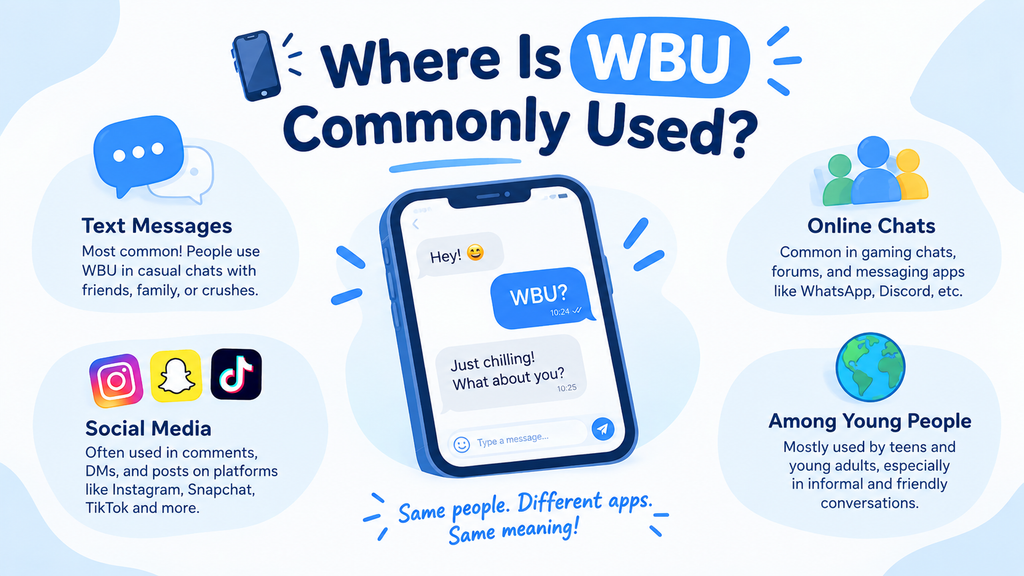
WBU lives almost entirely in casual, digital conversation. You won’t see it in a business email, but you’ll see it constantly in chat apps.
📍 Common Platforms:
- Text messages (SMS/iMessage)
- Instagram and Snapchat DMs
- WhatsApp and Facebook Messenger
- TikTok comments and captions
- Discord and group chats
- Online gaming chat (Roblox, Fortnite, Xbox/PS party chat)
🧩 Tone & Style:
WBU is casual, friendly, and low-effort by design. It fits best in:
- Conversations with friends, classmates, or online acquaintances
- Light, everyday small talk
- Fast-paced back-and-forth texting where nobody wants to type full sentences
💬 Examples of WBU in Conversation
Here’s how WBU typically shows up in real chats:
- “I’m just chilling at home, WBU?”
- “Had a long day at school lol, WBU?”
- “Watching a movie rn, WBU?”
- “Not much, just scrolling TikTok. WBU?”
- “Good, thanks for asking! WBU?”
Notice the pattern: someone answers a question first, then flips it back with WBU instead of writing “What about you?” in full.
🕓 When to Use and When Not to Use WBU
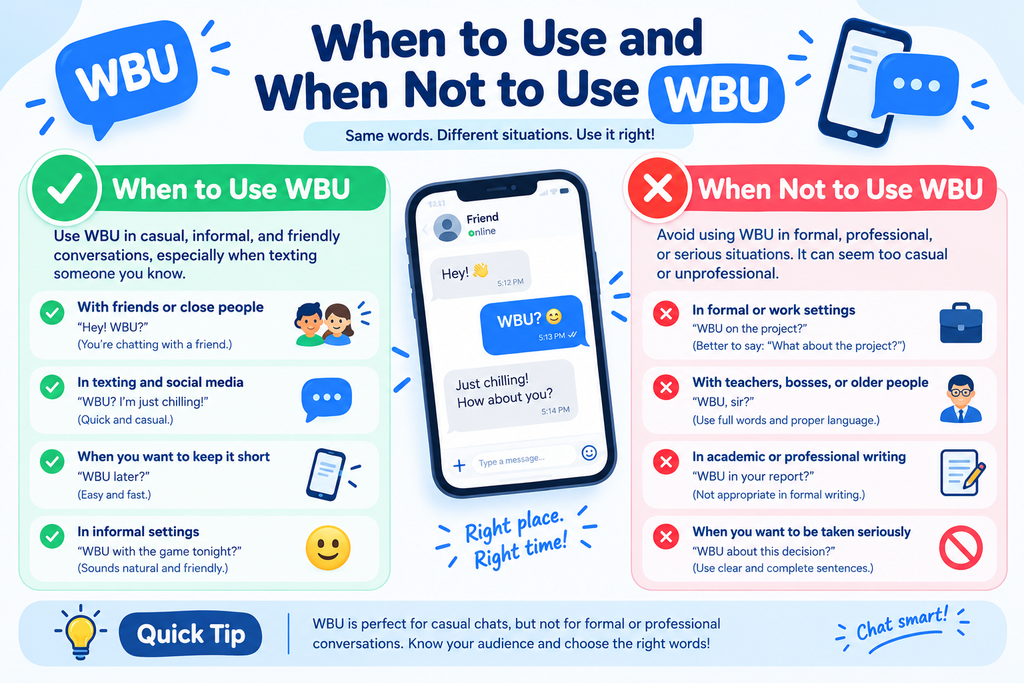
WBU is handy, but it’s not a one-size-fits-all phrase. Context matters.
✅ When to Use WBU
- Texting friends, siblings, or classmates
- Casual chats on social media
- Replying to “how are you” or “what are you doing” type questions
- Fast-moving conversations where brevity is normal
❌ When Not to Use WBU
- Emails to a boss, teacher, or client
- Formal messages (job applications, official inquiries)
- First conversations with someone in a professional setting
- Any context where full, polished sentences are expected
🔄 Other Meanings of WBU in Text
While “What About You?” is by far the most common meaning, WBU can occasionally stand for other things depending on context — like an organization name, a school abbreviation, or a niche internet term. These uses are rare and almost always obvious from context, so if a message doesn’t make sense as “what about you,” it’s likely referring to something unrelated to texting slang, such as an institution or acronym specific to that conversation.
🔄 Similar Slang Words or Alternatives
WBU has a few close cousins that mean the exact same thing or something very similar.
| Slang | Meaning | Common Use |
|---|---|---|
| WBU | What about you? | Bouncing a question back |
| HBU | How about you? | Nearly identical to WBU |
| WBY | What about you? | Alternate spelling, same meaning |
| SUP | What’s up? | Casual greeting/check-in |
| WYD | What are you doing? | Asking about current activity |
| HRU | How are you? | Checking in on someone’s wellbeing |
WBU and HBU are essentially interchangeable — the choice usually just comes down to personal texting habits.
🧠 Why People Use WBU Instead of Full Sentence
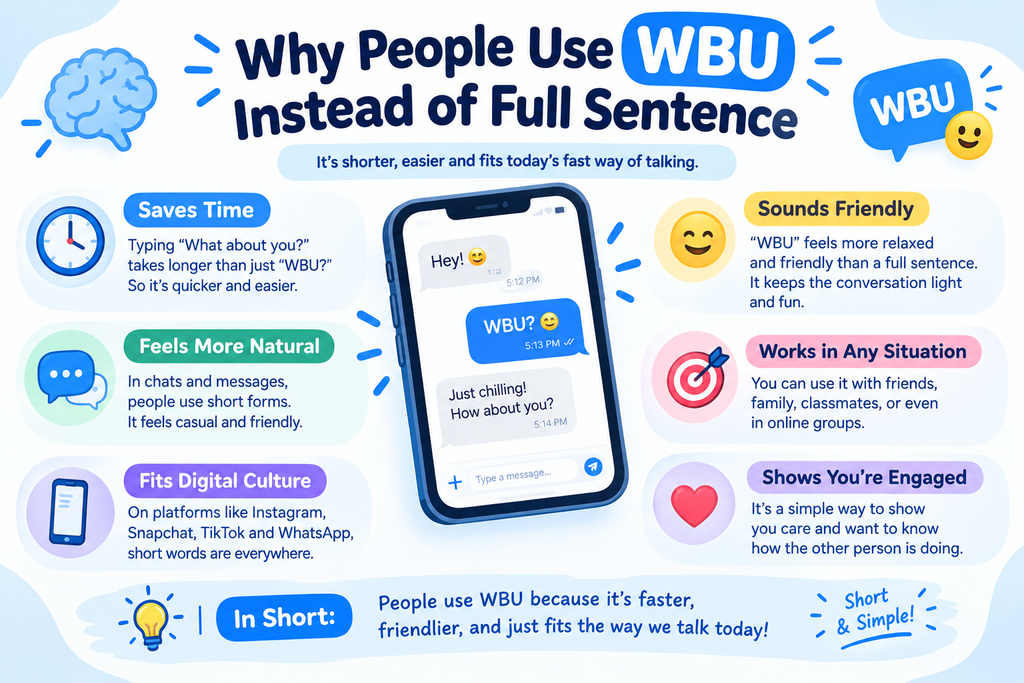
Texting culture runs on speed and simplicity, and WBU fits right into that mindset.
⚡ 1. Saves Time
Typing three letters is a lot faster than typing “what about you?” every single time.
📱 2. Keeps Chats Fast
Short replies keep the conversation moving, especially in quick back-and-forth texting.
😎 3. Feels Natural
Acronyms like WBU have become part of everyday digital language, especially for younger texters.
💬 4. Easy to Understand
Even people who don’t use WBU themselves usually understand it instantly from context.
😊 Is WBU Friendly or Formal?
WBU sits firmly on the casual end of the spectrum, but its friendliness depends on who’s using it.
😊 Friendly Use:
Between friends, WBU feels warm and conversational — it shows genuine interest in the other person’s day.
😐 Neutral Use:
Among acquaintances or new online contacts, WBU works as a light, low-pressure way to keep a conversation going.
❌ Not Formal:
In professional or formal writing, WBU can come across as too casual or even unprofessional, so it’s best avoided there.
❓Frequently Asked Questions
❓ What does WBU stand for?
WBU stands for “What About You?” — a quick way to turn a question back on the person you’re chatting with.
❓ Is WBU the same as HBU?
Yes, WBU and HBU (“How About You?”) are used interchangeably and mean essentially the same thing.
❓ Is WBU rude?
No, WBU isn’t rude — it’s simply casual and best used in informal conversations rather than formal ones.
❓ Can I use WBU in formal writing?
It’s not recommended; formal writing calls for the full phrase “What about you?” instead of the abbreviation.
❓ Why do people use WBU?
People use WBU to save time, keep conversations fast, and match the casual tone of texting and social media.
❓ Where is WBU mostly used?
WBU is most common in texting, DMs, and chat apps like Instagram, Snapchat, WhatsApp, and Discord.
🧾 Final Thoughts
WBU is a small acronym that does a lot of conversational work — it’s a fast, friendly way to keep a chat flowing without repeating a full question. Stick to it in casual texting and social media, save the full phrase for formal settings, and you’ll always use it the right way.
