You jump into a lobby, and someone types, “This character is so OP.” Another player replies, “Nerf it already.” If you’re new, that exchange can feel like a different language.
So, what does OP mean in gaming? In almost every game chat, OP means overpowered. It describes a character, weapon, ability, or strategy that is so strong it throws the game off balance.
This guide covers where the term shows up, how to use it, what else it can mean, and the slang that goes with it.
🧠 What Does OP Mean in Gaming Chat?
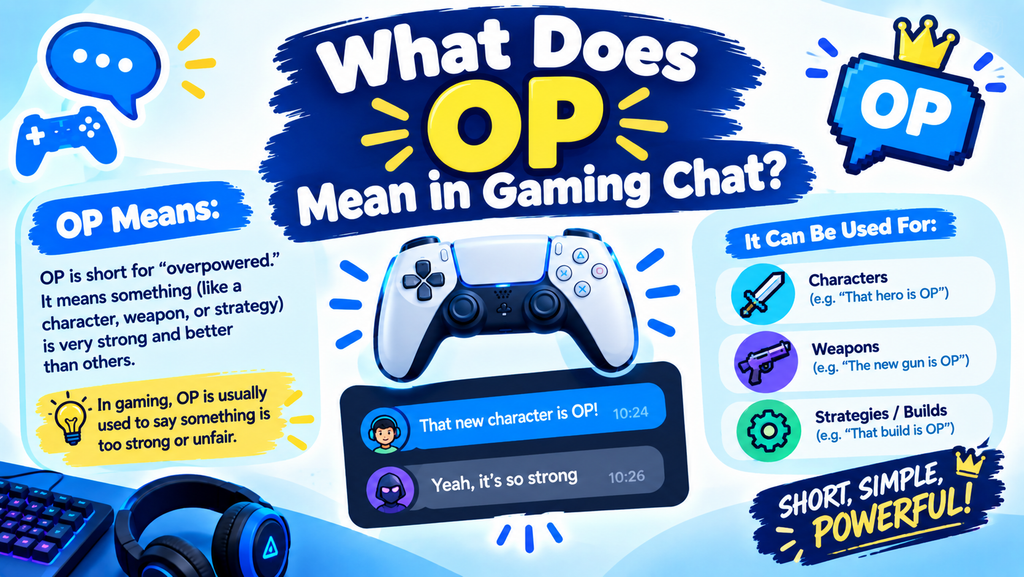
OP stands for “overpowered.” In gaming chat, it means something is much stronger than other options in the same game, to the point where it feels unfair or hard to counter.
Players usually apply it to:
- Characters or heroes that win too many matches
- Weapons that out-damage everything else
- Abilities or skills with no real weakness
- Builds and strategies that dominate the meta
- Items that give a huge edge for little cost
The idea is game balance. Developers try to make each option strong in some ways and weak in others. When one option beats nearly everything, the community calls it OP.
Some quick examples of how the word works:
- “That sniper rifle is OP at close range.”
- “Her ultimate is just OP.”
- “This build is OP right now, enjoy it before the patch.”
The label isn’t permanent. Something can be OP in one update and ordinary in the next, depending on what the developers change.
Related terms you’ll see alongside OP
OP rarely travels alone. These words usually appear in the same conversations:
- Nerf: a patch that weakens something that’s too strong
- Buff: a patch that strengthens something that’s too weak
- Broken: so strong it seems to break the game’s balance
- Meta: the strategies and picks currently considered the best
- Underpowered (UP): the opposite of OP
The word “nerf” comes from the Nerf toy brand, known for soft foam toys. The idea is that a weakened item becomes as harmless as a foam sword.
📱 Where Is OP Commonly Used?
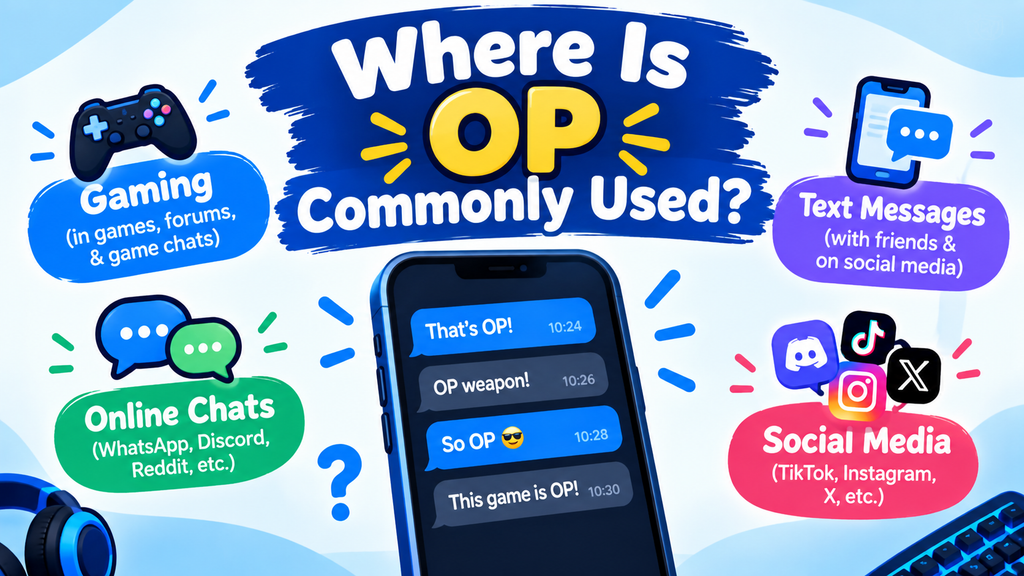
OP shows up wherever gamers talk to each other. You’ll see it most in the places below.
| Where | How OP is used | Example |
|---|---|---|
| In-game text and voice chat | Quick reactions during or after a match | “That gun is OP.” |
| Discord servers | Debating balance and builds | “Is the new hero OP or just fun?” |
| Reddit and forums | Patch discussions and tier lists | “Top 5 OP builds this season” |
| Twitch and YouTube comments | Reacting to a play or a streamer’s pick | “Chat, this class is OP” |
| Patch note discussions | Calling for developer changes | “Please nerf, it’s OP” |
| Text messages with gaming friends | Casual talk about a game | “Bro, the new map is OP for snipers” |
The term works in shooters, MOBAs, battle royales, RPGs, fighting games, and card games. Basically, if a game has a balance debate, OP will be in it.
Tone Check
Tone is where people get tripped up. OP can sound like three different things:
- Complaint: “This boss is OP, I can’t beat it.” Here the player feels something is unfair.
- Compliment: “Your build is OP!” Here the player is impressed.
- Joke: “My teammate is OP (he’s carrying us).” This is playful and friendly.
Context, punctuation, and emojis usually tell you which one it is. A frustrated message tends to come with “pls nerf.” A friendly one tends to come with “lol” or “GG.”
💬 Examples of OP Meaning in Gaming Chat in Conversation
Here are a few realistic exchanges so you can see OP in action.
Example 1: Complaining about a loss
Player A: How did he win that fight?
Player B: That shotgun is OP. Needs a nerf.
Example 2: Praising a strategy
Player A: Try the fire build on this boss.
Player B: Wow, that’s OP. Got it first try.
Example 3: Talking about a patch
Player A: Did they change the sniper?
Player B: Yeah, it got nerfed. It was way too OP.
Example 4: Joking with friends
Player A: Why do you always win?
Player B: I’m just OP. Skill issue on your side. 😎
Example 5: Strategy talk
Player A: What should I main this season?
Player B: Pick the tank. It’s OP right now.
🕓 When to Use and When Not to Use OP
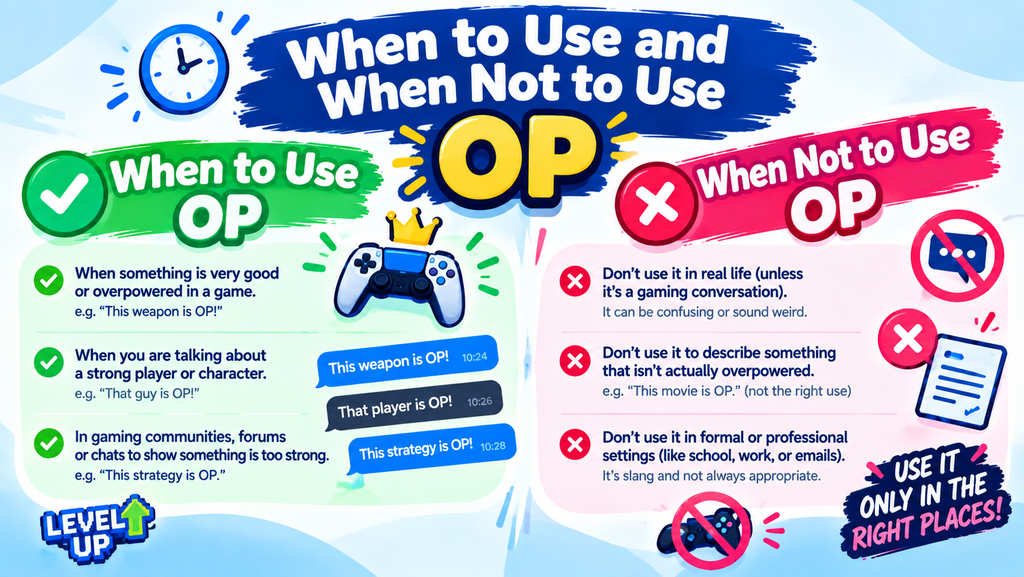
OP is easy to use, but it works better in some places than others.
✅ When to Use OP
- Casual gaming chat. It’s normal slang with friends and teammates.
- Balance discussions. It’s useful when talking about patches, tier lists, or the meta.
- Strategy talk. It quickly tells others that a pick or build is worth trying.
- Community posts. Forums and Discord servers use it constantly.
- Reacting to a big play. It works as a quick compliment.
❌ When NOT to Use OP
- Formal or professional writing. Write “overpowered” in full, or use “dominant” or “unbalanced.”
- Non-gaming audiences. Someone outside gaming may read it as “original poster” or not understand it at all.
- Mixed contexts. If a thread has both gamers and general forum users, spell out “overpowered” once to avoid mix-ups.
- After a loss, if you want to avoid arguments. Calling an opponent’s pick OP can come across as an excuse. Players often answer with “skill issue.”
- When you actually mean something else. Check whether you’re talking about balance, skill, or luck before using the word.
🔎 Other Meanings of OP
OP isn’t only a gaming word. Here are the other common meanings and where you’ll find them.
| Meaning | Where it’s used | Example |
|---|---|---|
| Original Poster | Reddit, forums, comment sections | “OP never answered the question.” |
| Original Post | Forums and social media | “Check the OP for the full rules.” |
| Out of Pocket | Social media slang | “That joke was OP.” |
| One Piece | Anime communities | “OP chapter drops today.” |
| Opening | Anime and TV | “That OP song is a banger.” |
| Operator | Game servers (like Minecraft) | “Give him OP so he can use commands.” |
| Operation | Military, medical, business | “The op went smoothly.” |
| Opportunity | Casual speech | “A photo op” |
The two you’ll bump into most are overpowered and original poster. A simple rule helps:
- In a game chat or a patch discussion, OP means overpowered.
- In a forum or comment thread, OP usually means the person who started it.
One extra gaming note: on servers like Minecraft, “OP” can mean someone has operator permissions, meaning admin-level control. If someone says “make me OP,” they’re asking for those powers, not saying they’re strong.
🔄 Similar Slang Words or Alternatives
If you want to vary your vocabulary, these terms point in the same direction as OP.
| Slang | Meaning | Example |
|---|---|---|
| Broken | So strong it breaks game balance | “That combo is broken.” |
| Busted | Unfairly powerful, a bit more informal | “This item is busted.” |
| Meta | Currently one of the best options | “It’s the meta pick.” |
| Cracked | Describes a very skilled player | “He’s cracked at this game.” |
| Goated | The greatest, often a compliment | “That character is goated.” |
| S-tier | Top rank in a tier list | “She’s S-tier this patch.” |
| Game-breaking | Ruins fair play | “That glitch is game-breaking.” |
| Underpowered / UP | Too weak, the opposite of OP | “This hero is UP.” |
| Nerfed | Weakened by a patch | “They nerfed the shotgun.” |
A small distinction: “OP” usually describes the thing (a weapon or character). “Cracked” usually describes the player. Mixing them up is a common beginner mistake.
⚖️ Is OP Always Negative?
No. OP leans negative when the subject of the sentence is something the speaker has to fight against. It leans positive when the speaker is the one using it.
| Situation | Tone | Example |
|---|---|---|
| Losing to it | Negative | “This boss is OP. Impossible.” |
| Using it | Positive | “My build is OP, I’m cruising.” |
| Praising a friend | Positive | “You were OP tonight.” |
| Joking | Playful | “I’m OP, you’re just bad.” |
| Reporting balance issues | Neutral | “The healer is OP in ranked.” |
This is why the same word can start an argument in one chat and get a high-five in another. Many players enjoy powerful picks until the picks start beating them.
There’s also a bigger debate behind the word. Some players think using an OP pick shows low skill. Others say it’s fair game if everyone has access. A different problem appears when the strongest items are locked behind a paywall. Then OP can turn into a “pay-to-win” complaint, which communities dislike far more.
❓ Frequently Asked Questions
1. Does OP always mean Overpowered?
No. In gaming it almost always means overpowered, but in forums it usually means original poster. Context decides.
2. Is OP a compliment?
It can be. Saying a build or a player is OP is often praise, though it can also be a complaint about something unfair.
3. What’s the opposite of OP?
The opposite is “underpowered” (UP), meaning something is too weak compared to other options.
4. Is OP used outside gaming?
Yes. People also use it for “original poster,” “out of pocket,” “One Piece,” and “operation,” depending on where they’re talking.
5. Why do gamers say OP?
It’s a short, fast way to say something is too strong, which matters when you’re typing mid-match or arguing about game balance.
📝 Final Thoughts
So, what does OP mean in gaming? It means overpowered: a character, weapon, ability, or strategy that’s stronger than it should be. It can be a complaint, a compliment, or a joke, and you tell which by reading the context and the tone.
Use it freely in casual gaming chats, Discord servers, and balance discussions. Switch to “overpowered” in full when you’re writing for a mixed or professional audience, and watch for the other meanings, especially “original poster” on forums.
Now that you know the word, along with nerf, buff, meta, and broken, you can follow most patch-note arguments without getting lost. And if your favorite pick is OP this season, enjoy it. A nerf is probably coming.
