
You open a message and see one word: “gud.” Is your friend happy, bored, or just typing fast?
Quick answer: Gud means good. It’s a casual, phonetic spelling used in texts, DMs, comments and game chat. It usually sounds relaxed and friendly. In gaming, “git gud” is a different thing entirely, and this guide covers that too.
Below you’ll find the meaning, the five most common uses with examples, how gud differs from good and gd, and when it’s better to type the full word.
What Does Gud Mean in Text?
Simple Meaning of Gud in Text
In texting, gud is slang for “good.” It’s an informal, non-standard spelling that mirrors how the word sounds when you say it quickly. People use it to answer questions, give praise, send wishes, and add a playful tone.
A few quick examples:
- “How was the movie?” → “gud, you’d like it”
- “Gud morning!”
- “That outfit looks gud on you”
The meaning rarely changes. What changes is the tone. Depending on the sender, gud can be sweet, jokey, lazy, or a little sarcastic.
Where Does Gud Come From?
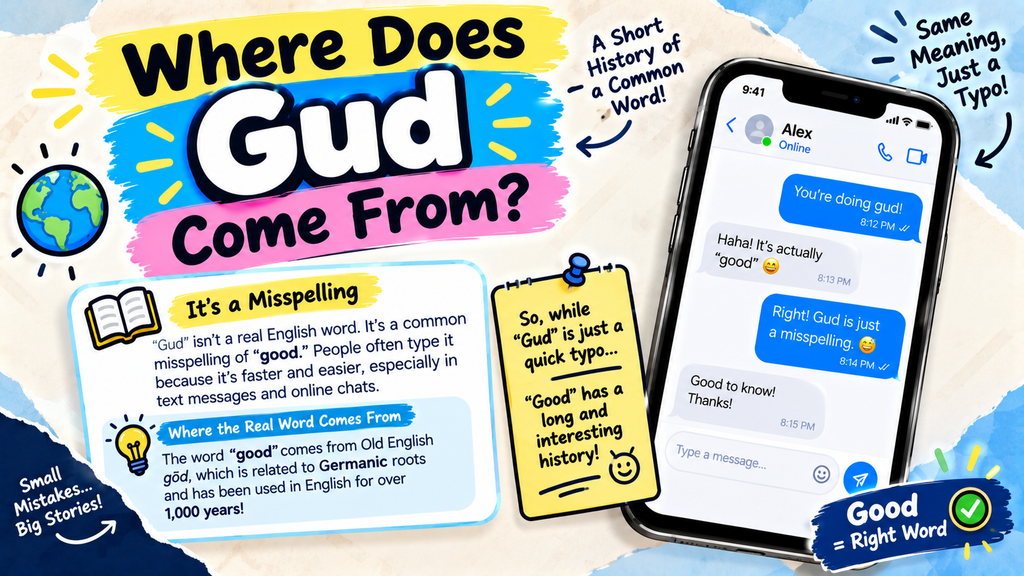
Nobody can point to one inventor or one date. Gud is what linguists call an “eye-dialect” spelling: you change the letters so the word looks like casual speech. Early chat rooms, SMS character limits and instant messaging all rewarded short, fast typing, and gud fit right in.
The gaming version has a clearer paper trail. Dictionary sources note that “git gud” (a spoken-style twist on “get good”) showed up in online gaming forums around 2009 and had spread widely by about 2013.
Where Is Gud Used?
You’ll see gud almost anywhere people type casually:
- Text messages and WhatsApp chats between friends and family
- Instagram and TikTok comments under photos and videos
- Snapchat and DMs, where short replies are normal
- Discord and gaming lobbies, especially in the “git gud” form
- Memes and captions, where odd spellings add humor
You’ll rarely see it in emails to a boss, school essays or official notices. Those still call for “good.”
Why Do People Write Gud Instead of Good?
There are four main reasons:
- Speed. Fewer keystrokes, faster reply.
- Tone. The misspelling feels softer and less formal than “good.”
- Humor. Playful spelling signals “I’m not taking this too seriously.”
- Belonging. Using the same slang as your friends makes a chat feel familiar.
Sometimes it’s also plain habit. People who type gud all day stop noticing it.
5 Uses of Gud in Text (With Examples)
Use 1: A Quick Answer to “How Are You?”
This is the most common use. It’s short, easy and low-effort.
- “Hey, how’s your day going?” → “gud, just tired”
- “How’s the new job?” → “gud so far”
Tone check: gud here is a relaxed “fine, thanks,” not a big announcement.
Use 2: Praising Someone
People use gud to compliment effort or results in a casual way.
- “Gud job on the presentation!”
- “This pasta is so gud”
- “Gud one 😂”
It reads as friendly approval. Add an emoji and it feels warmer still.
Use 3: Greetings and Wishes
Greetings are another place where gud shows up a lot, often paired with other short forms.
- “Gud morning ☀️”
- “Gud nite, sleep well”
- “Gud luck on your exam!”
These are sweet, everyday messages. Close friends and partners use them often because they feel casual and personal.
Use 4: “Git Gud” in Gaming
“Git gud” means “get good,” as in improve your skills. It started in online gaming communities and works two ways:
- Playful: a friend beats you and says “git gud 😎”
- Mocking: a stranger says it to a struggling beginner
Some people find the phrase dismissive, especially when it’s thrown at someone who just needs help. Gamers also borrow it outside games, for example when learning a language or an instrument. Read the room before you use it with someone new.
Use 5: Playful and Cute Talk
Sometimes gud is simply part of a goofy, affectionate voice.
- “You’re a gud boy” (said to a dog or a friend)
- “That’s a verrry gud idea”
- “Gud gud gud”
Repetition and stretched letters make it sound cute. It’s common in meme culture and between couples.
A Bonus Example: Sarcastic Gud
Gud can also carry sarcasm. If someone writes “oh gud, another Monday,” they don’t mean it. The context, an eye-roll emoji or an obvious complaint gives it away.
A Quick Group Chat Example
Sam: gm everyone
Riya: gud morning!! gud luck with the interview today
Sam: thanks, gud vibes only 🙏
Leo: if it goes gud, drinks are on you
Four messages, four slightly different gud moods: greeting, wish, vibe, and a joke.
Gud vs Similar Terms
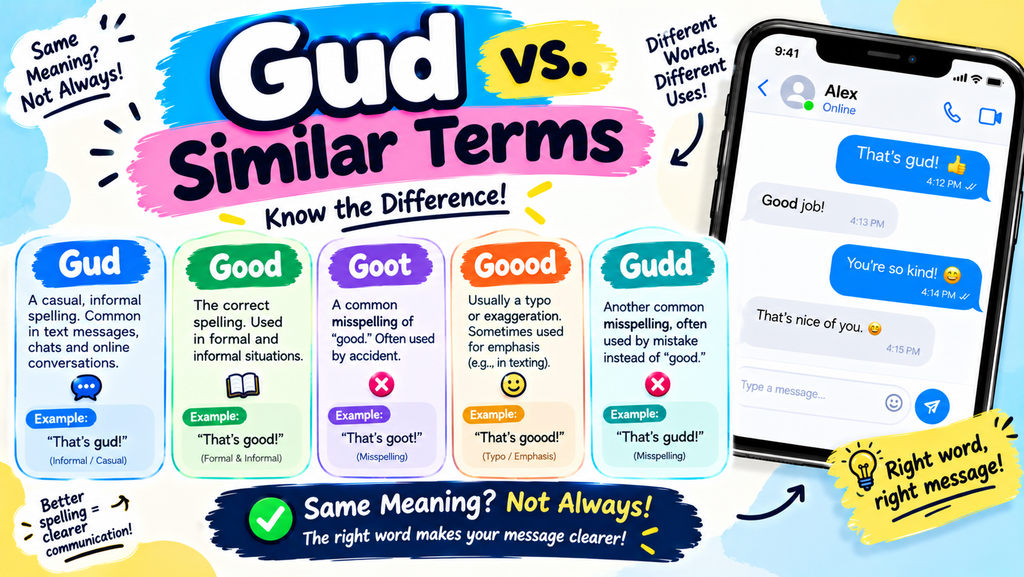
What Is the Difference Between Gud and Good?
Good is the standard spelling and works anywhere. Gud is the casual, chatty version. They mean the same thing, but gud adds a playful or relaxed feel and doesn’t belong in formal writing.
What Is the Difference Between Gud and Gd?
Gd drops the vowel and is purely about speed. Gud keeps the vowel sound, so it reads more like speech. Gd can also be confused with other things, such as “GD” for other abbreviations, while gud is easier to read at a glance.
| Term | Meaning | Tone | Best for |
|---|---|---|---|
| Good | Standard spelling | Neutral | Any situation |
| Gud | Casual spelling of good | Friendly, playful | Texts, DMs, comments |
| Gd | Short form of good | Rushed, minimal | Quick replies |
| Git gud | Get good (improve) | Joking or mocking | Gaming chats |
Other Casual Spellings You Will See Next to Gud
Gud rarely travels alone. These shortcuts often appear in the same chats:
- gm / gn: good morning / good night
- nite: night
- gr8: great
- luv: love
- thx: thanks
- gud vibes: good vibes
- gudluck: good luck
Seeing several of these in one message usually tells you the whole tone is relaxed.
When Should You Use Gud in Text?
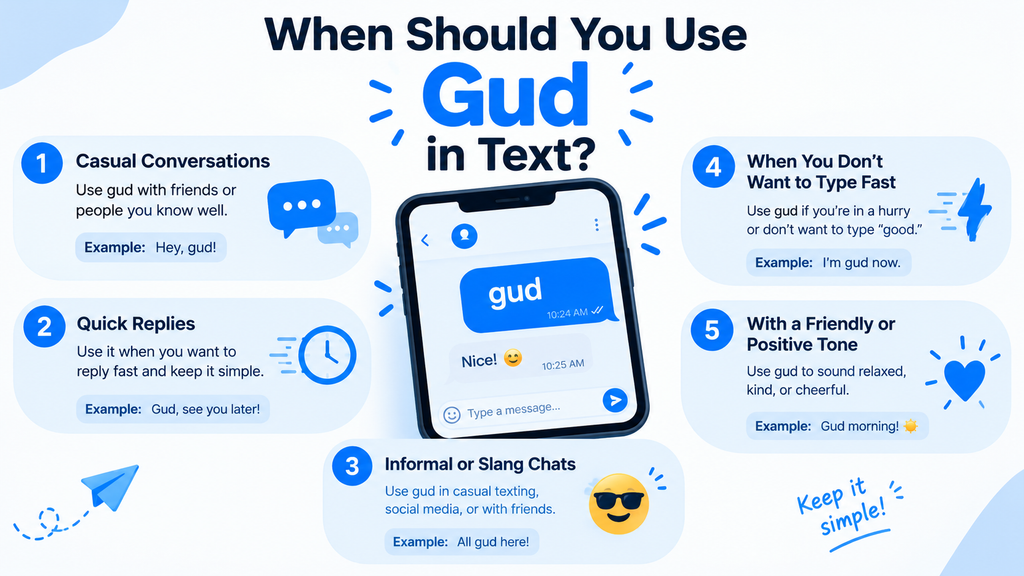
Good times to use it:
- Chatting with friends, siblings or your partner
- Commenting on social media posts
- Joking in a group chat or gaming lobby
- Sending a quick good-morning or good-night message
Skip it when:
- Writing to a manager, client or teacher
- Sending a job application or formal email
- Writing anything that will be graded or published
- Texting someone who may not know the slang, such as an older relative
A simple rule: if you’d say it in casual speech, gud is fine. If you’d dress up for it, type “good.”
Common Misunderstandings About Gud
The word looks the same in other languages and contexts, which can cause confusion:
- Danish, Norwegian and Swedish: gud means “God.” A Scandinavian friend writing it isn’t using slang at all.
- Hindi and Urdu: gud (written gur in many places) refers to jaggery, an unrefined sugar.
- Organizations: “GUD” can be a company or group name, so check the context.
- Typos: Sometimes it’s just a slip, not a style choice.
How to Tell If Gud Is a Typo or a Style Choice
- Repetition. If the sender writes gud every time, it’s deliberate.
- Other slang. Words like “nite,” “luv” or “gr8” nearby suggest a casual style.
- Emojis and stretched letters. “Guuud 😂” is clearly playful.
- Their usual style. Someone who writes carefully and slips once probably made a typo.
When in doubt, answer the meaning and ignore the spelling.
How to Reply When Someone Texts You “Gud”
Match their energy and keep it light:
- If they’re answering “how are you?”: “Glad to hear it! 😊”
- If they’re praising something: “Thanks, that means a lot!”
- If it’s a morning or night greeting: “Gud morning to you too!”
- If it sounds sarcastic: “Rough day? Tell me more.”
- If you’re unsure: “Gud gud 😄” works almost anywhere.
Does Writing Gud Hurt Your Spelling?
For most adults, no. People switch easily between casual chat and proper writing, just as they switch between slang and careful speech.
It can matter more for students and language learners who are still building spelling habits. If that’s you, keep slang to your personal chats and double-check homework, emails and anything formal.
Pro Tips for Using Gud Like a Native
- Match the vibe. Use gud only where the chat is already casual.
- Don’t overdo it. One gud per message sounds natural. Five sounds forced.
- Pair it with emojis when you want to keep the tone warm and clear.
- Mind your audience. If you’re unsure whether someone will get it, write “good.”
- Watch “git gud.” It’s funny between friends and rude toward newcomers.
- Be consistent. Switching between gud, gd and good in one message looks messy.
Final Thoughts: So, What Does Gud Mean in Text?
Gud is simply a relaxed way to write good. It can answer “how are you,” praise a friend, wish someone luck, joke around in a game, or add a cute, playful touch. The word is easy to decode once you look at context and tone.
Use it freely with friends, keep it out of formal writing, and remember that in a Scandinavian chat or a Hindi conversation, it may mean something else entirely.
Frequently asked question
1. What does gud mean in text?
Gud is a casual, phonetic spelling of “good,” used in texts, DMs and online comments to sound relaxed or playful.
2. Is gud the same as good?
Yes, the meaning is identical. The difference is style: “good” is standard and works everywhere, while “gud” is informal slang.
3. What does “git gud” mean?
“Git gud” is gamer slang for “get good,” meaning improve your skills. It can be a friendly joke or a mocking jab, depending on who says it.
4. Can I use gud in a work message?
It’s best avoided. Stick with “good” in professional emails and chats, and save “gud” for friends and casual conversations.
