
So what does OK mean in text? Two letters — no warmth, no punctuation, sometimes no context — and yet it can end a conversation, confirm a plan, or quietly signal that something’s wrong.”
This guide breaks down every layer of “OK” — where it shows up, what it signals in different situations, and how to tell a friendly nod from a cold shoulder.
🧠 What Does OK Mean in a Text?
At its core, “OK” is a marker of agreement or acknowledgment. It tells the other person: I heard you, and I’m fine with it.
But in texting, meaning isn’t just carried by the word itself — it’s carried by everything around it. Capitalization, punctuation, response time, and even emoji (or the lack of one) all shape how “OK” lands. A lowercase “ok” sent instantly usually reads as relaxed. A capitalized “OK.” sent after a long pause can feel clipped, final, or even irritated.
That’s why the same word can mean total agreement in one thread and quiet frustration in another — context is everything.
📱 Where Is OK Commonly Used?
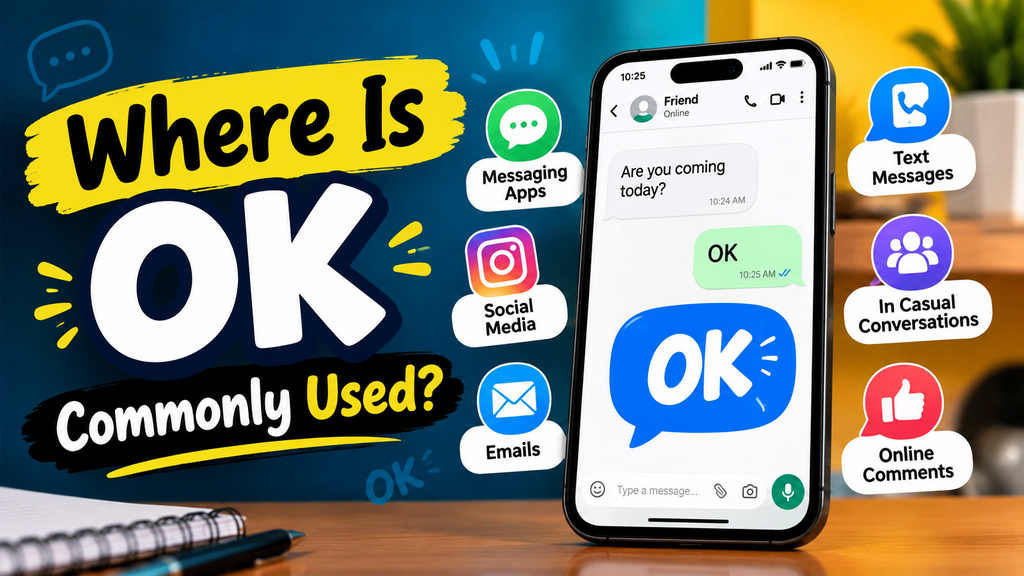
“OK” is one of the few words that works across virtually every messaging platform, age group, and language. Its simplicity is exactly why it spread so far.
📍 Popular Platforms:
- Text messages (iMessage, SMS, Android Messages)
- WhatsApp and Messenger
- Instagram and Snapchat DMs
- Workplace tools like Slack and Teams
- Gaming chats on Discord or in-game voice/text
🧩 Tone & Style:
- Casual chats: short, lowercase, often paired with emoji
- Professional messages: capitalized, sometimes softened with “Sounds good” instead
- Gaming and fast-paced chats: shortened further to “k” or “kk”
💬 Examples of OK in Conversation
1. Agreeing to Plans
“Let’s meet at 7?” — “ok see you then 😊” Here, OK simply confirms the plan without needing extra explanation.
2. Confirming Information
“Meeting moved to 3pm.” — “OK, noted.” This use is purely functional — an acknowledgment, not an emotional response.
3. Accepting Help
“I can pick up the kids today.” — “Ok, thank you so much!” Paired with gratitude, OK feels warm and appreciative rather than dismissive.
4. Parent Text
“Text me when you land.” — “ok mom” Short replies like this are common in family texting and rarely mean anything negative — it’s just efficient communication.
5. Gaming Chat
“Push mid now!” — “k” In fast-paced games, brevity is about speed, not attitude.
6. Workplace Chat
“Can you send the report by noon?” — “OK, will do.” Professional, clear, and to the point — ideal for workplace communication.
7. Slightly Cold Reply
“I really think we should talk about this.” — “OK.” No emoji, no elaboration — this version often signals discomfort, disagreement, or a desire to end the topic.
🕓 When to Use and When Not to Use OK
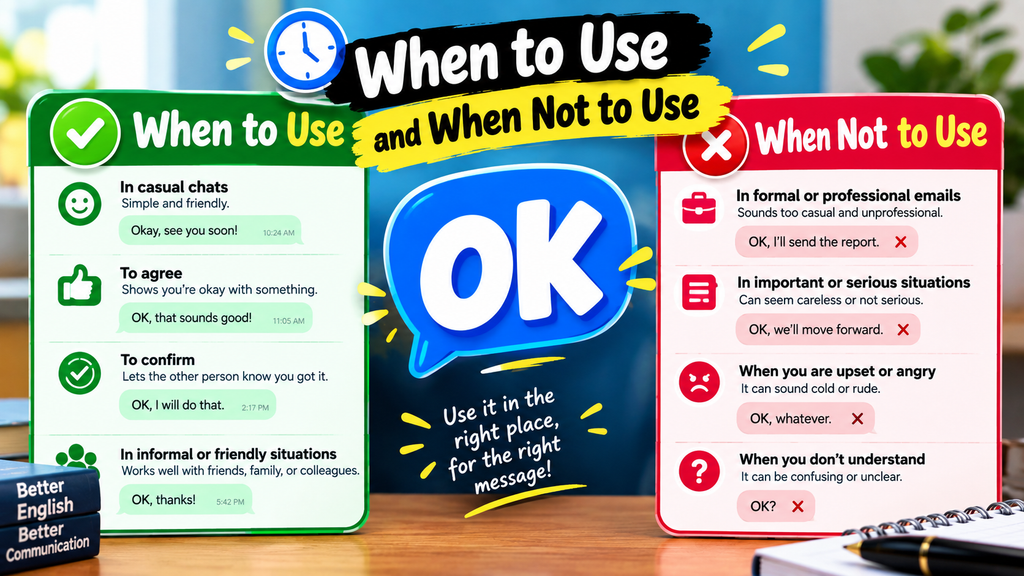
✅ When to Use OK
- Confirming plans or schedules
- Acknowledging instructions quickly
- Responding to simple yes/no questions
- Keeping fast-paced chats moving
❌ When Not to Use OK
- Responding to emotional or sensitive messages
- Replying to an apology (a bare “OK” can feel dismissive)
- Answering something that needs real feedback or detail
- When the other person is clearly seeking reassurance
🔄 Other Meanings of OK in Text
| Variation | Common Meaning | Example |
|---|---|---|
| ok | Casual agreement | “ok let’s do that” |
| Ok. | Slightly formal, clipped | “Ok. Noted.” |
| OK | Neutral confirmation | “OK, sounds good” |
| okay | Warmer, softer tone | “okay!! see you soon” |
| k | Very casual, sometimes curt | “k” |
| kk | Friendly, informal double confirmation | “kk sounds great” |
🔄 Similar Slang Words or Alternatives
| Word/Phrase | Vibe | Best Used For |
|---|---|---|
| Sure | Easygoing agreement | Casual plans |
| Alright | Relaxed confirmation | Friends, informal chats |
| Got it | Clear acknowledgment | Work or instructions |
| Bet | Enthusiastic agreement (Gen Z slang) | Social, informal chats |
| Roger | Playful/military-style confirmation | Joking tone |
| Fr (for real) | Agreement with emphasis | Casual, expressive texting |
🧠 Why Do People Use OK Instead of Longer Replies?
⚡ 1. It’s Quick
Typing two letters is faster than crafting a full sentence, especially mid-conversation.
📱 2. Keeps Conversations Moving
Short replies prevent a chat from stalling, especially in back-and-forth exchanges.
😊 3. Everyone Understands It
Unlike newer slang, “OK” needs no explanation — it transcends age, region, and platform.
🌎 4. Works Everywhere
From workplace Slack threads to casual DMs, OK fits almost any context without sounding out of place.
😊 Is OK Friendly or Rude?
This is where most confusion happens — because “OK” isn’t inherently positive or negative. It’s a blank canvas that takes on the tone of everything around it.
😊 Friendly Examples
- “Ok!! Can’t wait 😊”
- “ok sounds perfect, see you then”
😐 Neutral Examples
- “OK, got it.”
- “Ok, I’ll check and let you know.”
😒 Can OK Sound Rude?
Yes — especially when it’s a lone, punctuated reply to something that clearly needed more engagement. A flat “OK.” with no emoji or follow-up often reads as annoyance, especially among younger texters where tone-through-punctuation is a real digital norm.
📖 How OK Is Used on Social Media
👻 Snapchat
Often paired with reaction emoji or a Bitmoji rather than standing alone.
🎵 TikTok
Common in comment sections as a quick reaction, often exaggerated (“okkkkk” or “OK???”).
Used in DMs similarly to texting — tone depends heavily on punctuation and emoji.
🎮 Gaming Chats
Almost always shortened to “k” or “kk” for speed during active gameplay.
💼 Workplace Apps
Typically written in full (“OK”) and paired with a clear next step, keeping things professional.
❓ Frequently Asked Questions
❓ What does OK stand for?
Its most widely accepted origin is “oll korrect,” a playful 1830s misspelling of “all correct.”
❓ Is OK rude in texting?
Not inherently — but a flat, punctuated “OK.” with no elaboration can come across as dismissive or annoyed.
❓ Is OK formal or informal?
It works in both settings; capitalization and punctuation usually determine which tone it carries.
❓ What’s the difference between OK and K?
“OK” feels neutral to friendly, while “k” alone often feels rushed or slightly curt.
❓ Can OK mean “yes”?
Yes, in most everyday contexts, OK functions as a quick, informal way of saying yes or I agree.
❓ Why do people type OK instead of “okay”?
It’s faster to type and feels equally clear, making it the default choice in quick digital conversations.
🧾 Final Thoughts
“OK” is proof that meaning in texting rarely comes from the words alone — it comes from timing, punctuation, and the relationship between the people texting. Most of the time, it’s simply a fast, efficient way to say “got it” or “sounds good.” But when it feels off, it’s usually not the word itself causing the reaction — it’s everything surrounding it.
Understanding this small but mighty word can save you from unnecessary overthinking — and help you respond with the right tone every time.
