
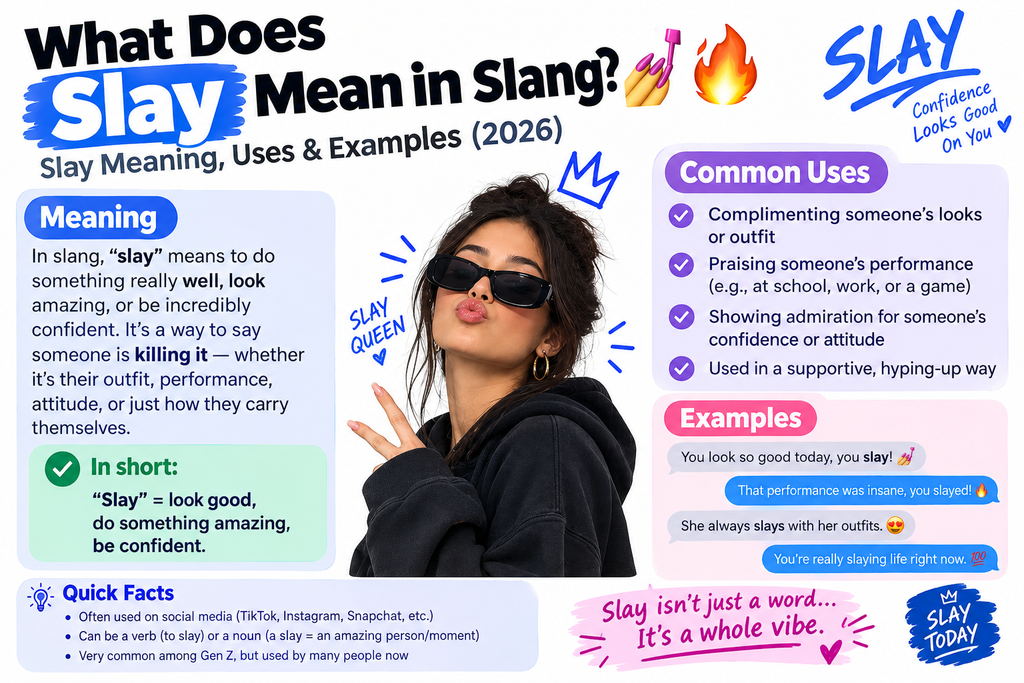
What does slay mean in slang? It’s a compliment that means someone did something exceptionally well or looks amazing. You’ll usually see it as a one-word comment (“SLAY”) under a great outfit, a big win, or a standout performance.
If you’ve ever wondered what does slay mean in slang, this guide has you covered. Slay is a slang compliment that means someone did something exceptionally well or looks amazing. Below you’ll find the meaning, origin, real examples, similar words, and simple tips on when to use it (and when to skip it).
🧠 What Does Slay Mean in Slang?
In slang, slay means to do something so well, or look so good, that it leaves a strong impression. It’s like saying “you nailed it” or “you killed it,” just with more sparkle. People use it for outfits, performances, jokes, achievements and confident attitudes.
The original meaning is much darker. Slay is a very old word with Old English roots, and it meant to kill, the kind you’d find in stories about knights and dragons. Slang kept the intensity and flipped the mood. If you “kill it” on stage, you slay.
Quick facts about slay
| Detail | Info |
|---|---|
| Word type | Verb, also used as an exclamation |
| Slang meaning | To excel, impress, or look amazing |
| Tone | Positive, hyped, playful |
| Slang past tense | Slayed (“She slayed that speech”) |
| Literal past tense | Slew / slain |
| Common with | Outfits, performances, confidence, wins |
| Popular on | TikTok, Instagram, X, Snapchat |
| Roots | Black and Latino LGBTQ+ ballroom culture |
📱 Where Is Slay Commonly Used?
You’ll spot slay online first, but it has spilled into everyday speech too.
📍 Popular platforms:
- TikTok: comments on outfit, dance and glow-up videos
- Instagram: captions and replies on selfies and Reels
- X (Twitter): fan reactions, especially around music, TV and award shows
- Snapchat and text chats: quick hype replies between friends
- YouTube and Twitch: comments on beauty, gaming and music content
- Real life: school hallways, campuses, casual workplaces and drag shows
🧩 Tone & Style:
- Excited and supportive
- Informal, and often typed in caps (SLAY)
- Stretched for emphasis (“slayyyy”)
- Paired with emojis like 💅🔥👑✨
- Often followed by “queen,” “girl,” or “bestie,” though it works fine alone
💬 Examples of Slay in Conversation
Here’s how slay sounds in real life.
| Situation | Example | What it means |
|---|---|---|
| Outfit | “That jacket? Slay.” | You look great |
| Work | “She slayed that presentation.” | She did an excellent job |
| Performance | “Slay, queen! That solo was perfect.” | Cheering someone on |
| Goals | “Go slay that exam.” | Go do great |
| Humor | “You slay me.” | You make me laugh so hard |
| Sarcasm | “Made my bed. Slay.” | Joking about a tiny win |
| Caption | “Slay all day 💅” | Confident, upbeat post |
And a quick text exchange:
Mia: I got the internship!!
Jo: SLAY. Knew you would 🔥
🕓 When to Use and When Not to Use Slay
Slay is casual, so context matters.
✅ When to Use Slay
- Hyping a friend’s outfit, new haircut or big win
- Commenting on social media posts
- Texting friends or peers who use similar slang
- Reacting to a great concert, drag show or video
- Joking about your own small victories
❌ When Not to Use Slay
- Formal emails, reports or cover letters
- Job interviews and client meetings
- Serious or sad moments, like when someone shares bad news
- News or legal settings, where “slaying” means murder
- Any time it feels forced. If it doesn’t sound like you, skip it.
🔄 Other Meanings of Slay in Slang
The compliment sense is the most common, but slay has a few other uses.
| Meaning | Example | Where you’ll see it |
|---|---|---|
| To kill (literal) | “The knight slew the dragon.” | Stories, games, news headlines |
| To make someone laugh hard | “Your jokes slay me.” | Older slang, still used |
| To overcome something | “Slay your fears.” | Motivational posts |
| Ironic praise | “Replied to one email. Slay.” | Memes and humor |
| Slay queen (regional) | In Kenya, often a criticism of a woman seen as flashy and dependent on rich partners | East African slang |
A few dictionaries also list a rarer adult sense tied to sex. Context makes it obvious, and it isn’t what people mean when they comment “slay” on a photo.
🔄 Similar Slang Words or Alternatives
If you want some variety, these work in similar situations.
| Word or phrase | Meaning | Example |
|---|---|---|
| Killed it | Did something really well | “You killed it tonight.” |
| Nailed it | Got it exactly right | “Nailed it!” |
| Ate (and left no crumbs) | Did it flawlessly | “She ate that performance.” |
| Served | Delivered a great look or attitude | “He served in that suit.” |
| Understood the assignment | Did exactly what the moment needed | “Perfect outfit. She understood the assignment.” |
| Iconic | Memorable and impressive | “That look was iconic.” |
| Yas, queen | Loud, happy approval | “Yas, queen!” |
| On fleek | Perfectly done (a bit dated now) | “Your brows are on fleek.” |
🧾 Why Is Slay So Popular?
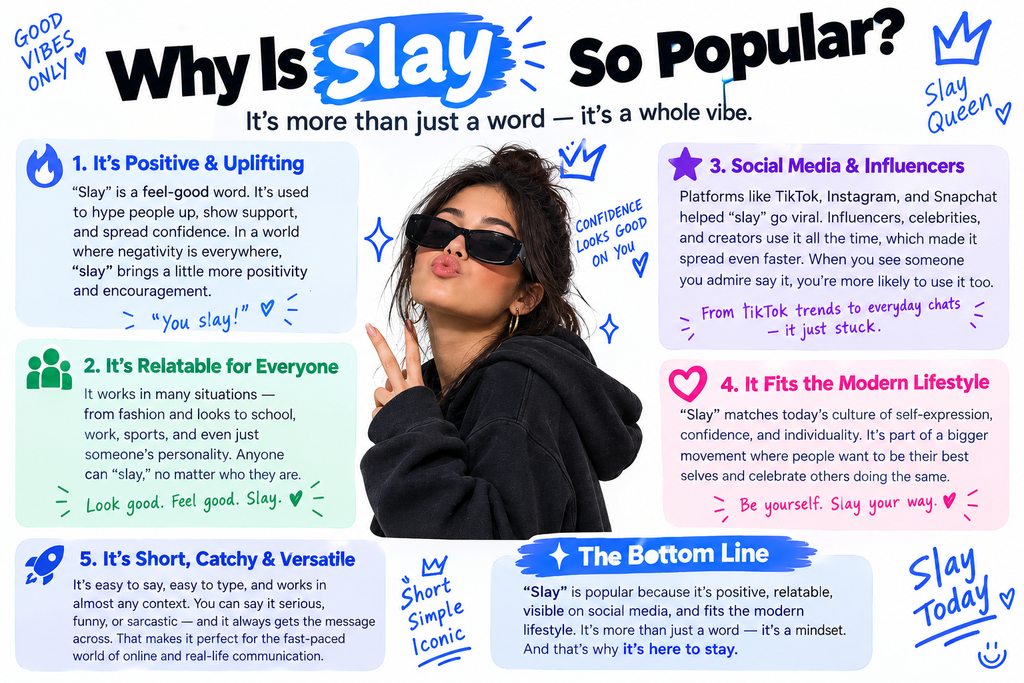
Reasons for popularity:
Slay didn’t blow up by accident. A few simple things pushed it from niche slang to everyday vocabulary.
🔥 1. Strong Energy
The word sounds sharp and confident. It’s one syllable with a hard landing, and it carries excitement without needing extra words.
💅 2. Easy to Use
It’s short and flexible. You can use it as a verb (“she slayed”), an exclamation (“slay!”), or a full comment on its own. No grammar stress.
📱 3. Social Media Friendly
One word fits any comment box, caption or reply. It pairs well with emojis and spreads fast through trends and videos.
😎 4. Positive Vibe
It celebrates people. In comment sections that can get harsh, slay is a fast way to lift someone up.
🧠 Is Slay Friendly or Rude?
Slay is almost always friendly. It’s a compliment, not an insult. The tone just depends on who says it and how.
😊 Friendly:
This is the most common use. You’re cheering someone on or celebrating a win, and nobody’s offended.
😐 Neutral:
Sometimes it’s just a reaction, like a quick comment under a stranger’s post. There’s no deeper meaning behind it.
😂 Playful:
Friends often say it as a joke about small things. That’s fine, but a flat “slay” after someone’s mistake can come across as mockery. Read the room.
🌍 Slay in Pop Culture
Slay’s rise is a real slang success story, and it didn’t start on TikTok.
- Old English roots: The word originally meant to strike or kill.
- 1920s: “You slay me” was a way to say someone made you laugh hard.
- 1970s–80s: Black, Latino and queer ballroom communities used slay for a flawless look, dance and attitude.
- 1991: The documentary Paris Is Burning put ball culture and its slang in front of a wider audience.
- 2009: RuPaul’s Drag Race brought drag language into mainstream living rooms.
- 2016: Beyoncé’s song “Formation” pushed the word into pop culture.
- 2020s: TikTok and Gen Z (plus Gen Alpha) turned it into an everyday compliment.
It’s worth remembering where the word came from. Slay grew out of Black and queer communities, and many people encourage others to credit that history rather than treat it as generic internet talk.
❓Frequently Asked Questions
❓ What does slay mean in slang?
It means doing something exceptionally well or looking amazing. Think “you killed it” with extra flair.
❓ Is slay a compliment?
Yes, almost always. The only exception is sarcastic use, which is usually obvious from context.
❓ Can slay be used for guys?
Absolutely. Slay isn’t tied to gender, so you can say it to anyone.
❓ Is slay formal?
No. It’s informal slang, best kept for friends, social media and casual chats.
❓ What’s similar to slay?
“Killed it,” “nailed it,” “ate,” “served” and “iconic” all carry a similar meaning.
❓ Why do people say slay?
It’s short, punchy and full of energy. Ballroom culture, drag shows, pop music and social media helped spread it.
🧾 Final Thoughts
So, what does slay mean in slang? It’s a quick, energetic way to say “you did that brilliantly” or “you look incredible.” It started in ballroom culture, traveled through drag and pop music, and landed in every comment section online.
Use it to lift friends up, keep it out of formal settings, and remember its roots. Used naturally, it’s one of the friendliest words in modern slang. Now go slay your day. 💅
