
Trying to figure out the NVM meaning behind a text you just got? If you’ve ever been mid-conversation and someone suddenly replied with just “nvm,” you already know it can feel a little confusing — or even a little cold. Is it dismissive? Is it casual? Is it something else entirely?
NVM stands for “never mind.” It’s one of the most widely used texting abbreviations, popping up in group chats, DMs, work Slack threads, and comment sections everywhere. People use it to cancel a question, drop a topic, or move past something that’s no longer worth explaining.
In this guide, you’ll learn exactly what NVM means, where it’s used, when it’s okay (and not okay) to use it, and how it compares to similar slang like NM, IDC, and JK. Let’s break it down.
📱 Where Is NVM Commonly Used?
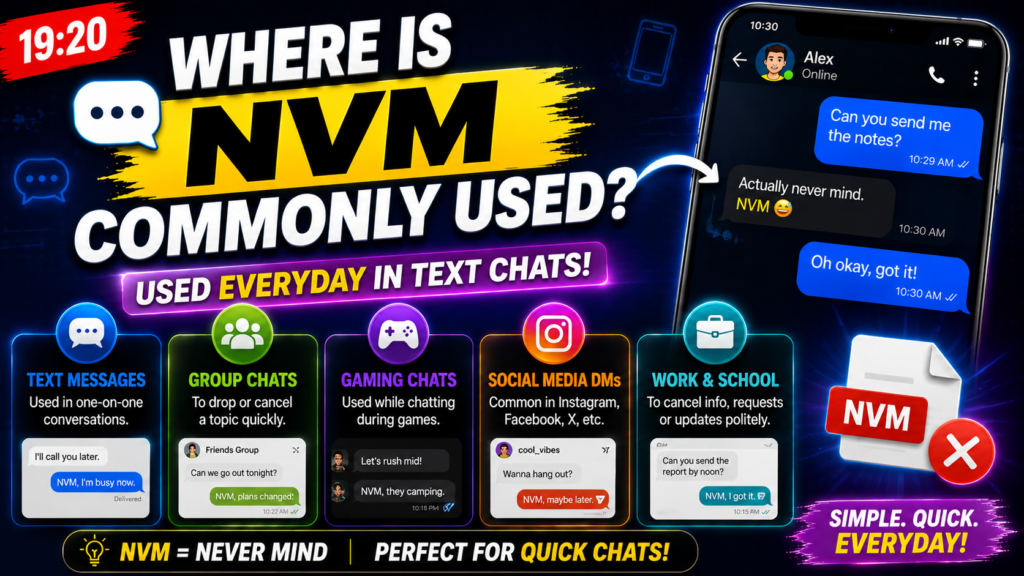
NVM shows up almost everywhere text-based conversation happens. It’s short, quick to type, and instantly understood by most digital-first audiences — which is exactly why it has stuck around for so long.
📍 Popular platforms:
- Text messaging (SMS/iMessage) — the original home of NVM, used to shut down a question quickly
- Instagram & Snapchat DMs — common in fast, back-and-forth chats between friends
- Discord & gaming chats — used mid-game when a plan changes or a question becomes irrelevant
- Twitter/X and TikTok comments — often used casually or sarcastically in replies
- Workplace chat tools (Slack, Teams) — used informally, though usually best avoided in formal threads
🧩 Tone & Style:
NVM is almost always informal. It works best in casual, friendly, or lighthearted exchanges. Depending on how it’s typed, it can come across as:
- Neutral — simply canceling a request (“nvm, found it”)
- Playful — used jokingly between close friends
- Passive-aggressive — when someone feels ignored or brushed off
- Abrupt — if used without context, it can read as short or dismissive
💬 Examples of NVM in Conversation
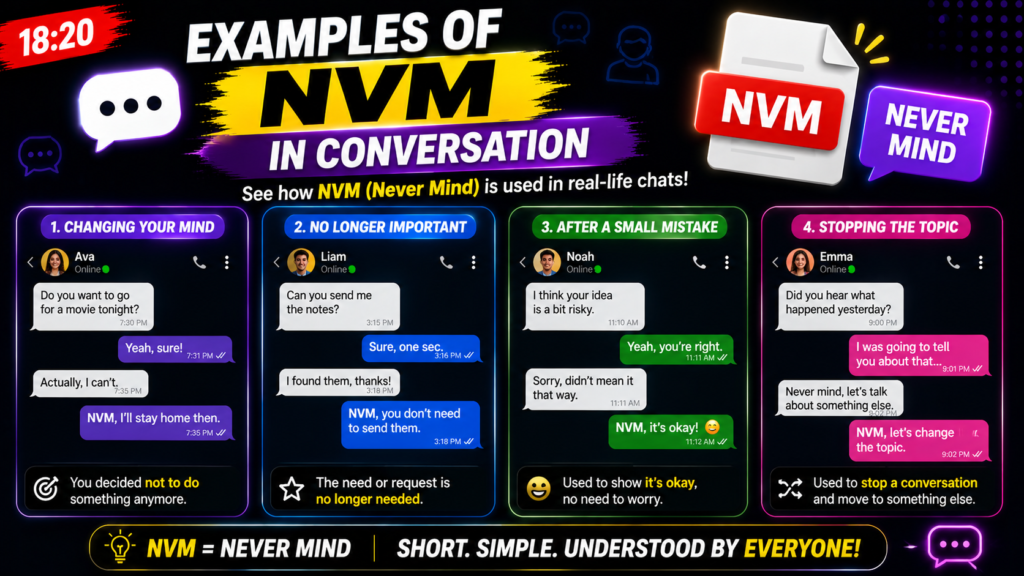
Seeing NVM in action makes its meaning much clearer. Here are a few real-world style examples:
- Alex: “Hey, do you remember the name of that restaurant?” Jamie: “Nvm, I just found it on Google.”
- Sam: “Can you send me the file when you get a chance?” Riley: “Wait nvm, I found it in my downloads folder.”
- Group chat: “Anyone free for dinner tonight?” “Nvm guys, plans got cancelled 😅”
- Sarcastic tone: “I asked you three times… nvm, I’ll just figure it out myself.”
- Gaming chat: “Should we push top lane? Nvm, they’re already retreating.”
In each case, NVM signals that the original question, request, or comment no longer needs a response — the situation has already resolved itself.
🕓 When to Use and When Not to Use NVM
Like most slang, NVM is situational. It works beautifully in some contexts and falls flat — or even seems rude — in others.
✅ When to Use NVM
- When your question has already been answered elsewhere
- When plans change and further discussion isn’t needed
- In casual chats with friends, family, or close coworkers
- To quickly move on from a small misunderstanding
- In gaming or fast-paced group chats where speed matters
❌ When Not to Use NVM
- In professional emails or formal business communication
- When talking to someone you don’t know well (it can seem curt)
- During a serious or emotional conversation
- In customer service or client-facing messages
- When clarity matters more than speed — spell it out instead
📊 Comparison Table: Context Usage of NVM
| Context | Is NVM Appropriate? | Better Alternative |
|---|---|---|
| Texting friends | ✅ Yes | — |
| Group chats / Discord | ✅ Yes | — |
| Gaming chats | ✅ Yes | — |
| Work Slack (casual team) | ⚠️ Sometimes | “No worries, I figured it out” |
| Formal work email | ❌ No | “Please disregard my earlier message” |
| Customer support chat | ❌ No | “That won’t be necessary, thank you” |
| Talking to a stranger online | ⚠️ Depends on tone | “Never mind, all good” |
🔄 Other Meanings of NVM in Text
While “never mind” is by far the most common meaning, NVM does have a few alternate meanings depending on the context it appears in:
- Non-Volatile Memory — a technical term used in computing and storage (e.g., flash memory, SSDs)
- NVM (Node Version Manager) — a developer tool used to manage multiple versions of Node.js
- Not Very Much — an occasional casual variant, similar in tone to “never mind”
- NVM (album) — a 2014 album by the band Tacocat
Outside of tech and niche communities, though, “never mind” remains the meaning you’ll encounter 95% of the time in everyday texting.
🔄 Similar Slang Words or Alternatives
If you’re mixing up your texting vocabulary, here are a few abbreviations that share a similar vibe to NVM:
- NM — “not much” or sometimes “never mind,” depending on context
- IDC — “I don’t care,” used when something no longer matters
- JK — “just kidding,” used to soften or cancel a previous statement
- FGT / FRGT — informal texting shorthand for “forget it”
- IG — “I guess,” often used to trail off a thought casually
- TBH — “to be honest,” sometimes paired with NVM in longer messages
❓Frequently Asked Questions
❓ What does NVM stand for in texting?
NVM stands for “never mind.” It’s used to cancel a question, request, or comment that’s no longer relevant.
❓ Is NVM rude in chat?
It can come across as short or dismissive without context, but among friends it’s usually harmless and casual.
❓ What is the difference between NVM and NM?
NVM almost always means “never mind,” while NM can mean either “not much” or “never mind” depending on the sentence.
❓ Can I use NVM in professional emails?
It’s best avoided in formal emails — use a full phrase like “please disregard my previous message” instead.
❓ Why do people use NVM instead of typing full words?
It saves time, matches the fast pace of digital conversation, and is instantly recognizable to most texters.
❓ Does NVM have any other meaning?
Yes — outside of texting, NVM can refer to Non-Volatile Memory in computing or Node Version Manager for developers.
🧾 Final Thoughts
NVM is a small abbreviation with a big presence in everyday digital conversation. At its core, it simply means “never mind” — a quick way to drop a topic, cancel a question, or move a conversation forward without over-explaining.
The key is context. Among friends and in casual chats, NVM is perfectly natural. In professional or formal settings, it’s worth typing out the full thought instead. Once you know how and when to use it, NVM becomes just another tool for keeping your texting fast, casual, and easy to understand.
