If you’ve spent five minutes in a TikTok comment section lately, chances are you’ve seen someone type “SYBAU” and wondered what on earth it means. It looks like a typo, reads like a code, and shows up everywhere from meme pages to Love Island discourse on X.
The short answer: it’s not friendly. SYBAU is one of the more aggressive acronyms currently circulating on TikTok, and understanding it will save you from an awkward moment the next time your feed — or your group chat — throws it at you. Here’s the full breakdown of the SYBAU meaning, where it came from, and how people actually use it in 2026.
🧠 What Does SYBAU Mean on TikTok?
SYBAU stands for “shut your b*tch a** up.” It’s a blunt, insult-laced way of telling someone to stop talking, usually aimed at someone who’s being annoying, argumentative, or just overstaying their welcome in a conversation.
Unlike a plain “shut up,” SYBAU carries extra bite because it tacks on a personal insult. That’s what separates it from softer slang like “hush” or “zip it” — it’s meant to sting a little.
The term isn’t actually new. It traces back to Urban Dictionary entries from as early as 2003, long before TikTok existed. What changed is that TikTok compressed it into a punchy five-letter acronym and gave it a second life in comment sections, duets, and reaction videos starting around late 2024.
📱 Where Is SYBAU Commonly Used?
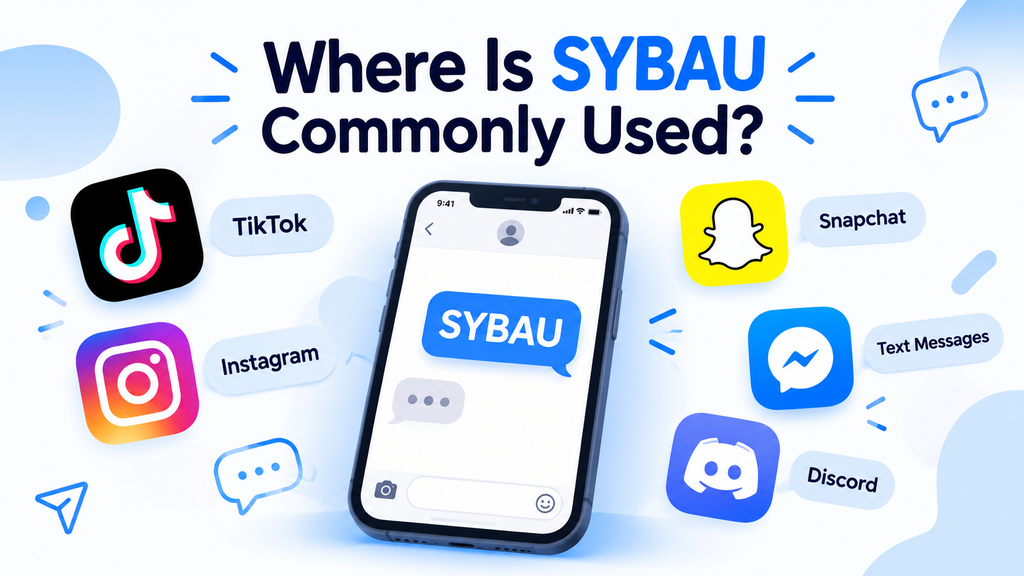
SYBAU shows up most often in fast, casual digital spaces where people want to shut down a point quickly:
- TikTok comment sections — replying to a take someone disagrees with
- Gaming chats — trash talk during competitive matches
- X (Twitter) — especially around reality TV discourse and spoiler arguments
- Group chats and DMs — often between friends, half-joking
- Meme captions — paired with slang like “TS,” “PMO,” and “ICL” for exaggerated, over-the-top posts
Tone Check
Context decides everything with this phrase. Between close friends, SYBAU often reads as a joke or a playful “stop it, oh my god” moment. Directed at a stranger or used in anger, it reads as exactly what it is — a hostile insult.
💬 Examples of SYBAU Meaning on TikTok in Conversation
Here’s how the term typically plays out in real exchanges:
In a comment section (aggressive use):
Comment: “This video is so cringe, who even watches this.”
Reply: “sybau, nobody asked 💀”
Between friends (joking use):
Friend 1: “I swear I almost became famous last week—”
Friend 2: “sybau, you did not”
On a gaming chat:
“sybau and just play the objective”
As a meme caption:
“when someone spoils the episode before you watch it: SYBAU 😭”
In every case, the underlying message is the same — stop talking — but the emotional temperature ranges from genuine anger to affectionate teasing.
🕓 When to Use and When Not to Use SYBAU
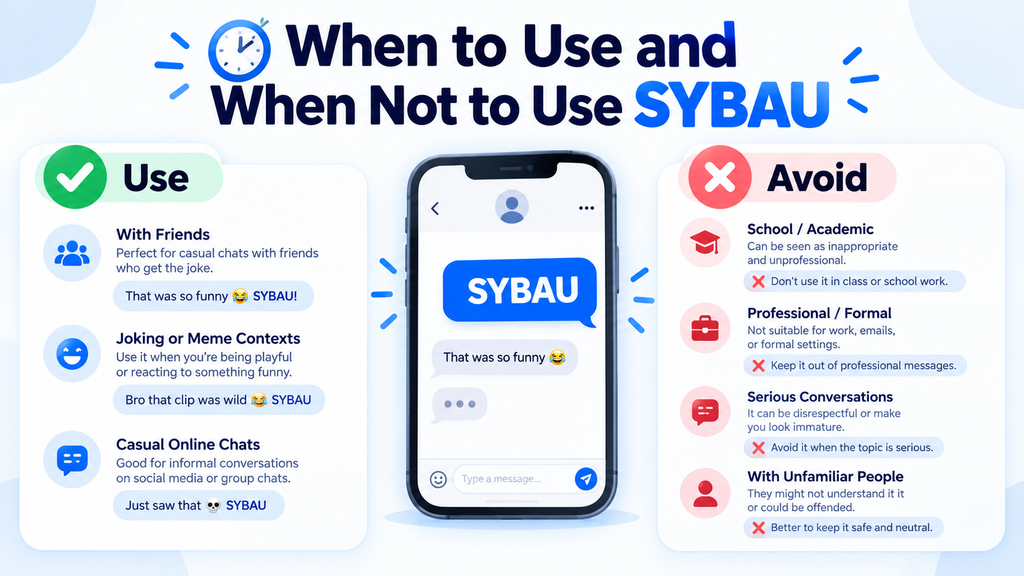
✅ When It’s (Sometimes) Used
- Joking around with close friends who share your humor
- Reacting to obviously exaggerated or “brainrot” content
- Roasting a friend’s over-the-top story
- Captioning a meme for comedic effect
❌ When NOT to Use It
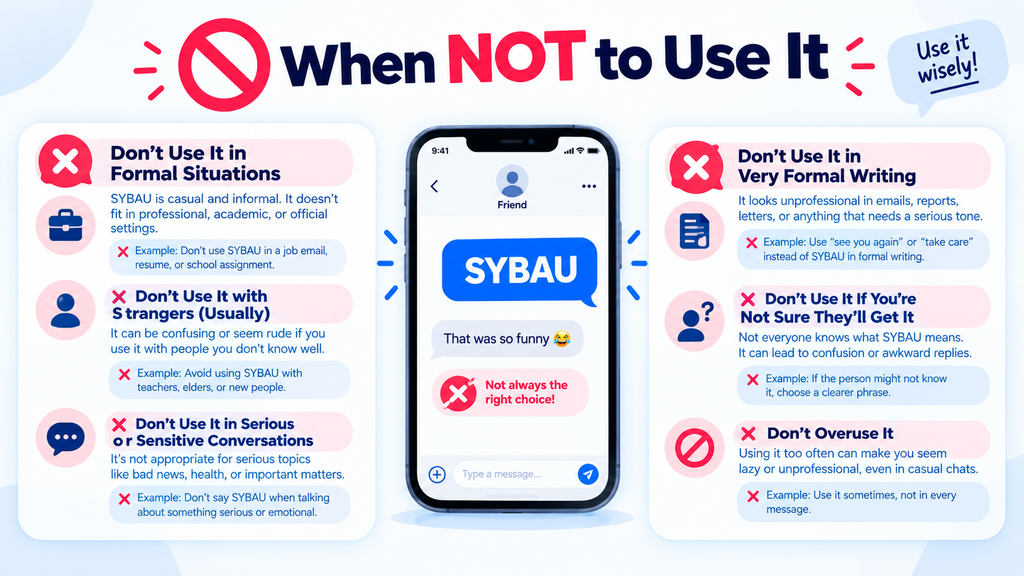
- In professional or work-related chats (Slack, Teams, email)
- Toward strangers or people you don’t know well
- In arguments that are already getting heated
- Toward someone who’s genuinely upset or venting
- On brand, business, or public-facing accounts
Because tone doesn’t translate well over text, a phrase meant as a joke can easily land as a real insult if the other person doesn’t know you well.
🔎 Other Meanings of SYBAU
The uncensored, original meaning is the dominant one, but a few sanitized or joking backronyms circulate too — mostly used by people trying to avoid the profanity or by teens giving parents a less alarming answer.
| Backronym | Where It’s Used | Tone |
|---|---|---|
| Shut your b*tch a** up | TikTok, X, gaming chats (original/primary meaning) | Aggressive, dismissive |
| Shut your big annoying [mouth] up | Family-oriented slang explainers, kid-safe rewordings | Softened, still dismissive |
| Shut your boring a** up | Used when someone finds a message tedious or dragged-out | Mocking, less angry |
| Stay Young, Beautiful and Unique | A joke answer teens sometimes give confused parents | Playful, not the real meaning |
If someone tells you SYBAU stands for something wholesome, they’re most likely being cheeky rather than accurate.
🔄 Similar Slang Words or Alternatives
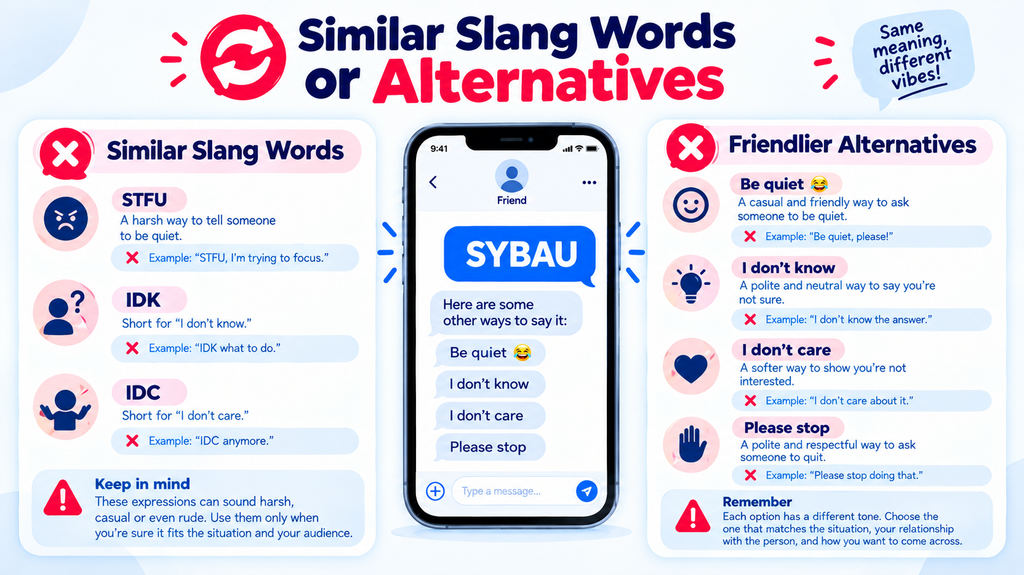
SYBAU belongs to a long lineage of internet acronyms built to shut a conversation down fast. Here’s how it compares to its closest relatives:
| Acronym | Meaning | Intensity | Typical Use |
|---|---|---|---|
| SYBAU | Shut your b*tch a** up | High | Insulting someone into silence |
| STFU | Shut the f*** up | High | Classic, widely recognized version |
| GTFO | Get the f*** out | High | Telling someone to leave, not just be quiet |
| SYB | Shut your b***h | Medium-High | Shorter, less specific precursor to SYBAU |
| WTF | What the f*** | Low-Medium | Expresses shock or confusion, not a command |
SYBAU sits closer to STFU in intensity, but it feels more personal because of the added insult.
⚠️ Is SYBAU Offensive?
Yes — taken literally, SYBAU is offensive. It combines profanity with a direct insult, which is why many articles and parenting resources flag it as inappropriate for kids, classrooms, or professional settings.
That said, offensiveness is heavily context-dependent online. Among peers who use it as a running joke, it functions more like exaggerated slang than a genuine attack. The confusion for parents, teachers, and newcomers usually comes from not knowing which version — joking or genuinely hostile — they’re looking at.
If you’re a content creator or brand, it’s safest to treat SYBAU as NSFW-adjacent slang and avoid using it in anything monetized or public-facing, since platforms and advertisers tend to flag profanity-based acronyms regardless of tone.
🌍 Why Is SYBAU Trending on TikTok?
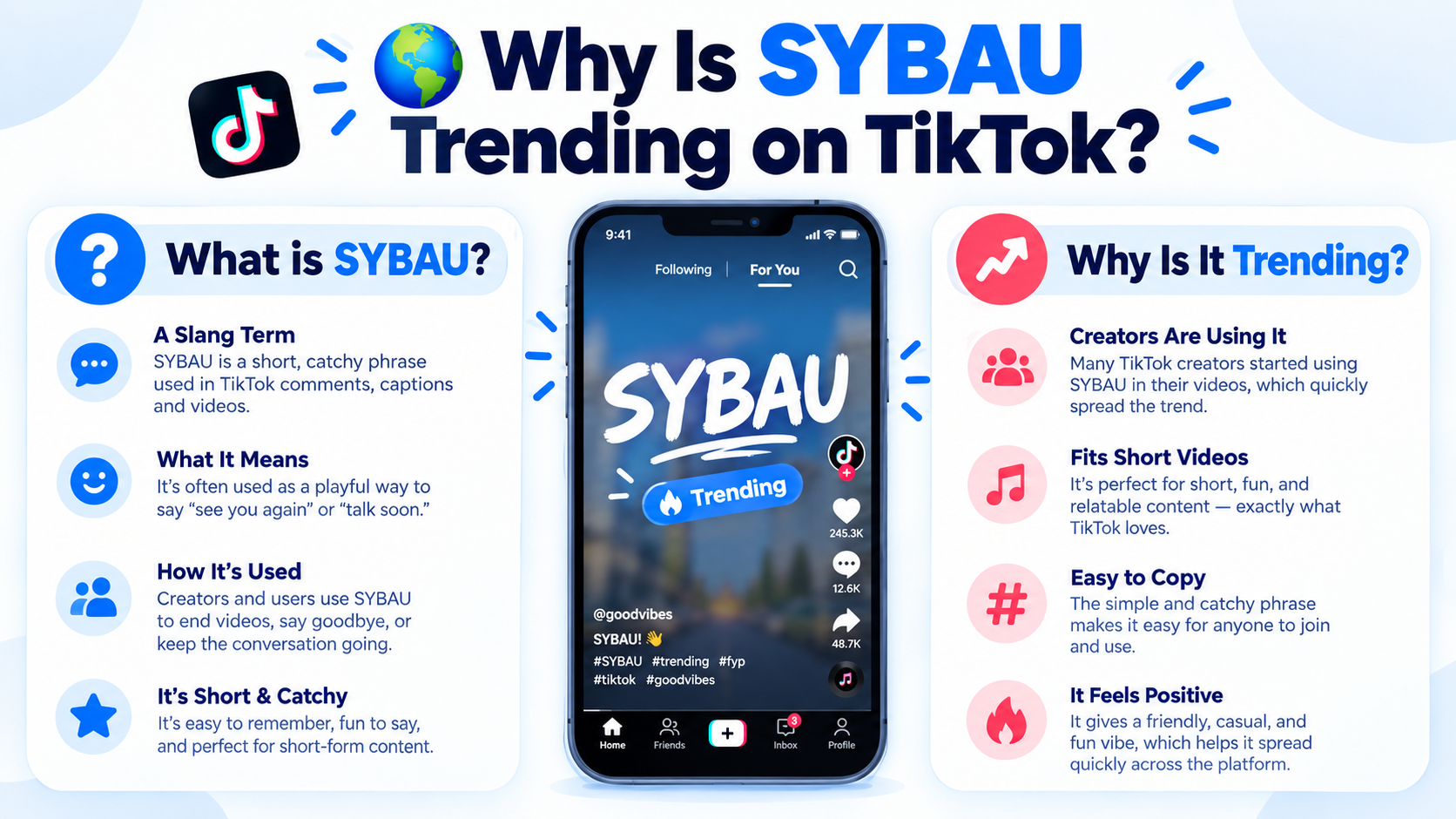
A few things pushed SYBAU into the mainstream:
- Short-form video rewards punchy language. A five-letter acronym is faster to type and read than a full sentence, which fits TikTok’s rapid comment culture.
- It bundles well with other slang. SYBAU frequently appears alongside terms like “TS,” “PMO,” and “ICL” in exaggerated “brainrot” memes designed to sound as chaotic as possible.
- It’s a generational marker. Using — or correctly decoding — SYBAU signals familiarity with current internet culture, similar to how older slang once separated insiders from outsiders.
- Algorithms reward controversy. Aggressive, attention-grabbing phrases tend to spread faster in comment sections, which fuels a feedback loop of usage.
❓ Frequently Asked Questions
1. Is SYBAU always rude?
Not always — the literal meaning is rude, but between friends it’s often used jokingly rather than as a genuine insult.
2. Can SYBAU be used jokingly?
Yes, it’s commonly used to playfully roast a friend, similar to saying “stop it, oh my god” in an exaggerated way.
3. Is SYBAU banned on TikTok?
It’s not officially banned, but because it contains implied profanity, it can sometimes trigger content moderation or limit a video’s reach.
4. Should I use SYBAU in comments?
Only with people who’ll clearly read it as a joke — avoid it with strangers, coworkers, or on professional accounts.
5. Is SYBAU common outside TikTok?
Yes, it’s spread widely to X (Twitter), Snapchat, Instagram DMs, and gaming chats.
📝 Final Thoughts
SYBAU is a good example of how old internet slang gets a second life through short-form video. The core meaning — an aggressive way of telling someone to be quiet — hasn’t changed since its 2003 origins, but TikTok’s comment culture turned it into a viral shorthand almost overnight.
Whether it lands as a joke or an insult comes down entirely to who’s saying it and why. When in doubt, save it for close friends who already know your sense of humor, and skip it everywhere else.
