
You’re scrolling through a group chat and someone types, “that’s just his mo lol.” No caps, no punctuation, just two letters that leave you staring at your screen. What does MO mean in text? You’re not alone in wondering — this tiny abbreviation shows up everywhere from Snapchat captions to Reddit threads, and its meaning shifts depending on who’s typing it.
This guide breaks down everything you need to know about MO: where it comes from, how people actually use it in 2026, and when you should (or shouldn’t) drop it into your own messages.
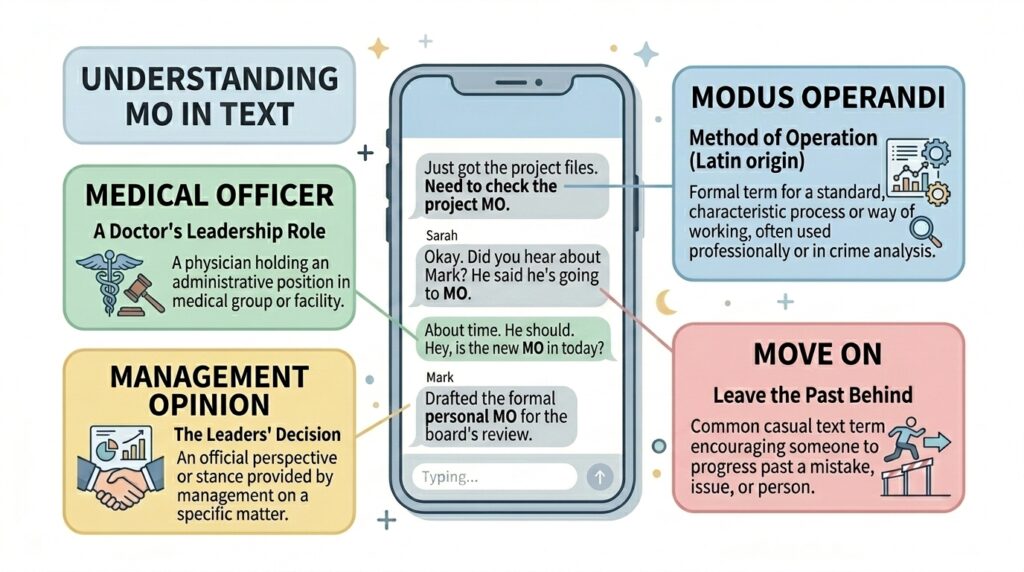
🧠 What Does MO Mean in Text?
In texting, MO most commonly stands for “modus operandi” — a Latin phrase that translates to “method of operating.” It describes someone’s usual way of doing something: their habits, routines, or typical behavior.
When a friend says, “showing up late is just his MO,” they mean lateness is that person’s signature move — something they do consistently enough that it’s basically their trademark.
Here’s the quick breakdown:
| Term | Meaning |
|---|---|
| Full form | Modus Operandi |
| Language origin | Latin |
| Literal translation | “Method of operating” |
| Texting meaning | Someone’s usual habit, style, or pattern of behavior |
| Tone | Casual to semi-formal |
The phrase originally belonged to legal and law enforcement language, describing how a criminal typically commits a crime. Over time, it slipped into everyday slang, and texters shortened it even further — dropping it into casual chats as just “mo” or “MO,” lowercase and all.
📱 Where Is MO Commonly Used?
MO isn’t tied to one app or platform. It travels easily because it’s short, easy to type, and works in almost any casual conversation.
📍 Popular Platforms
- Snapchat – used in captions and quick replies about someone’s habits
- TikTok – common in comment sections describing creators’ recurring behavior
- Instagram – shows up in captions and DMs
- WhatsApp – used in group chats when discussing a friend’s typical actions
- Twitter/X – used to comment on public figures’ predictable patterns
- Discord and gaming chats – used to describe a player’s usual strategy or move
🧩 Tone & Style
MO tends to sound casual, observational, and slightly playful. It rarely carries a strong emotional charge on its own — the sentence around it decides whether it reads as a compliment, a joke, or a mild criticism.
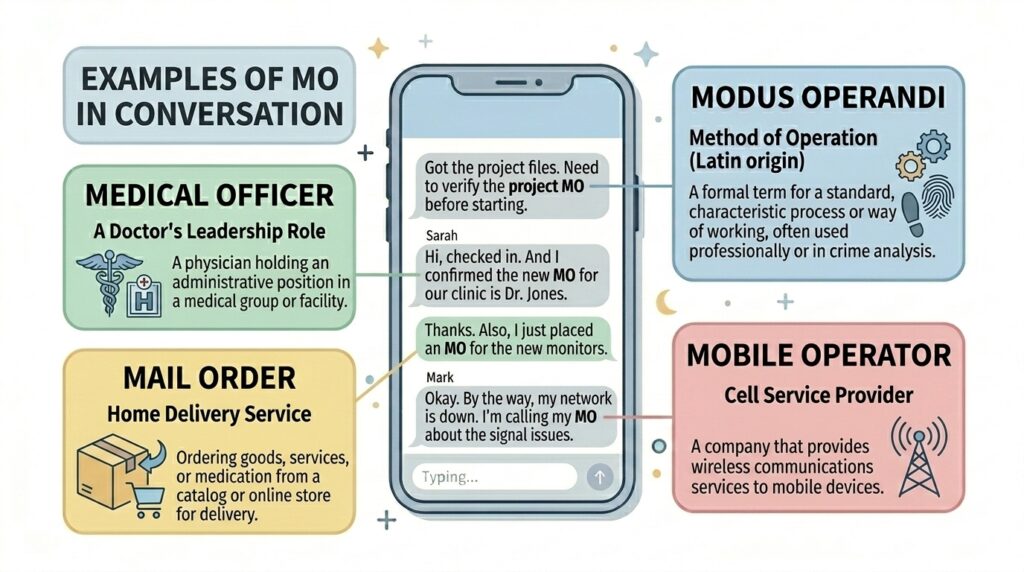
💬 Examples of MO in Conversation
Seeing MO used in real situations makes the meaning click faster than any definition alone. Here are examples across different everyday contexts.
1. Talking About Habits
Friend 1: “He canceled plans again?” Friend 2: “Yep, classic. That’s his mo at this point.”
2. Describing Someone
Text: “She always shows up fashionably late, it’s her whole mo.”
3. Funny Conversation
Text: “Eating fries before the burger even arrives is literally my mo.”
4. Family Chat
Mom: “Your brother forgot his jacket again.” You: “Lol that’s just his mo, he’ll survive.”
5. Gaming Chat
Teammate: “Watch out, camping near spawn is his mo every match.”
6. Social Media Comment
Comment: “Dropping a new song every Friday is literally this artist’s mo.”
7. Friendly Conversation
Text: “Overpacking for a two-day trip? Yeah, that’s so my mo.”
🕓 When to Use and When Not to Use MO
MO is flexible, but it’s not universally appropriate. Knowing the right moment to use it keeps your texts natural instead of confusing.
✅ When to Use MO
- Chatting casually with friends or family
- Describing a recurring habit or pattern
- Commenting on social media in a light, informal tone
- Talking about a character’s behavior in a show, movie, or game
❌ When Not to Use MO
- Professional emails or workplace messaging
- Formal writing, essays, or reports
- Conversations with someone unfamiliar with texting slang
- Situations where clarity matters more than brevity
🔄 Other Meanings of MO in Text
While modus operandi is the most common meaning, MO can stand for a few other things depending on context:
- Moment – “Give me a mo, I’ll be right there.”
- Missouri – the U.S. postal abbreviation for the state
- Money Order – used in financial contexts
- Molybdenum – the chemical symbol, relevant in science conversations
- A nickname – short for names like Mohammed, Maureen, or Morgan
- Month (as in $/mo) – common in pricing and billing, like “$10/mo”
Context is everything. A text about a subscription price and a text about someone’s personality will use “mo” completely differently.
🔄 Similar Slang Words or Alternatives
If you want to switch things up, these phrases carry a similar meaning to MO:
- “That’s so on-brand for them”
- “Typical [name] move”
- “Classic [name]”
- “That’s their thing”
- “Same old, same old”
- “Usual behavior”
🧠 Why Do People Use MO Instead of Saying “Usual Behavior”?
Texting slang exists for a reason, and MO fits neatly into how people communicate online today.
⚡ 1. It’s Shorter
Two letters versus multiple words — MO wins on speed every time.
📱 2. Makes Conversations Faster
Quick typing keeps casual chats flowing without breaking the rhythm of a conversation.
😎 3. Sounds Natural
Because MO has been part of pop culture for decades, it feels familiar rather than forced.
🔥 4. Popular in Movies and TV Shows
Crime dramas and detective shows normalized the term long before texting existed, so most people already recognize it.
😊 Is MO Friendly or Rude?
MO itself is neutral. It doesn’t carry positive or negative weight — the surrounding words determine the tone.
😊 Friendly Examples
“Bringing snacks to every hangout, that’s just your mo and we love it.”
😐 Neutral Examples
“He always parks in the same spot, it’s his mo.”
😒 Negative Examples
“Showing up late and blaming traffic? Classic mo.”
Conclusion
So, what does MO mean in text? Nine times out of ten, it’s shorthand for “modus operandi” — a casual way to point out someone’s usual habits, style, or pattern of behavior. It’s friendly, flexible, and shows up across nearly every messaging app and social platform. Just remember: keep it for casual chats, skip it in professional writing, and always let the context guide the tone.
Now that you know the meaning behind MO, you’ll never have to pause mid-scroll wondering what your friends are talking about again.
❓ Frequently asked questions
❓ What does MO stand for?
MO most commonly stands for “modus operandi,” a Latin phrase meaning someone’s usual method or way of doing things.
❓ What does MO mean in texting?
In texting, MO usually describes a person’s typical habit, behavior, or style.
❓ Is MO a slang word?
Yes, while it originates from Latin and legal language, MO is now widely used as casual internet and texting slang.
❓ Is MO rude?
No, MO is generally neutral — its tone depends entirely on the sentence it’s used in.
❓ Can MO have other meanings?
Yes, MO can also mean “moment,” “Missouri,” “money order,” or even “month” (as in $/mo), depending on context.
❓ Is MO popular on Snapchat and TikTok?
Yes, MO appears frequently in captions, comments, and chats across Snapchat, TikTok, and Instagram.
❓ Should I use MO in professional emails?
Generally, no. It’s best to write out phrases like “usual approach” or “typical method” in formal or professional communication.
