
Ever gotten a text so long you gave up halfway through? That’s exactly the moment “TLDR” was built for. If you’ve seen it pop up in a group chat, a Reddit post, or the end of a long email and wondered what it actually means, you’re in the right place.
This guide breaks down what TLDR stands for, where it comes from, how people use it across different platforms, and whether it’s actually rude to say. By the end, you’ll know exactly when — and when not — to drop a TLDR of your own.
🧠 What Does TLDR Mean in Text?
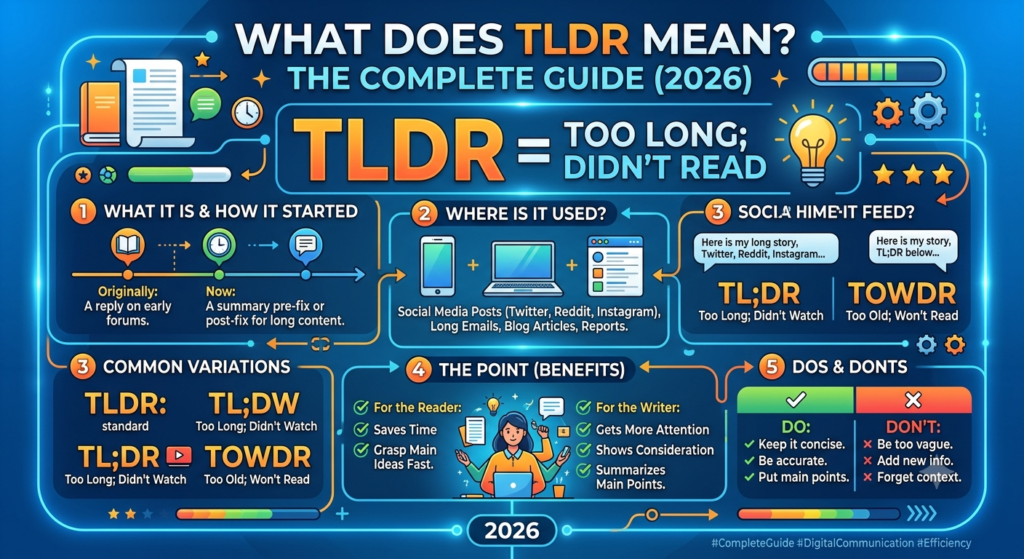
TLDR (also written TL;DR, TL DR, or tl;dr) stands for “Too Long; Didn’t Read.” It’s internet shorthand used to flag that a piece of text — a message, post, or article — is long enough that a reader either skipped it or wants a shortened version of it.
The phrase can work two ways in a conversation:
- As a summary marker — the writer condenses their own long message into one or two sentences, usually placed at the start or end.
- As a response — the reader uses it to admit they skimmed (or skipped) the message and would like the short version.
TLDR started life in early internet forums and message boards back in the late 1990s and early 2000s, where marathon-length posts were common and readers needed a quick way to flag — or request — the short version.
Example of TLDR in Text:
“Okay so my landlord raised the rent, the AC broke, my roommate moved out, and now I’m looking for a new place by next month. TLDR: I need to move, fast.”
Here, the TLDR line does the heavy lifting so the reader gets the gist even if they don’t read the backstory.
📱 Where Is TLDR Commonly Used?
TLDR shows up almost everywhere text-based communication happens, but the tone shifts depending on the platform.
📍 Popular Platforms:
| Platform | How TLDR Is Typically Used |
|---|---|
| Posted at the top or bottom of long story-style posts (common in r/AITA, r/relationships) | |
| Texting / iMessage / WhatsApp | Used casually to summarize a long text or respond to one |
| Added at the top of long work emails to highlight the key ask or decision | |
| Twitter/X & Instagram | Used in captions or threads to give a quick takeaway |
| Slack & workplace chat | Used to flag action items in long updates |
| Gaming chat & Discord | Used to sum up strategy discussions or patch notes |
🧩 Tone & Style:
- On Reddit and forums, TLDR is often formal-ish and genuinely helpful — it’s expected etiquette for long posts.
- In texting, it’s more playful and conversational.
- In email and business chat, it’s used to save the reader’s time and signal professionalism, not laziness.
- In gaming and Discord, it’s fast, blunt, and casual.
💬 Examples of TLDR in Conversation
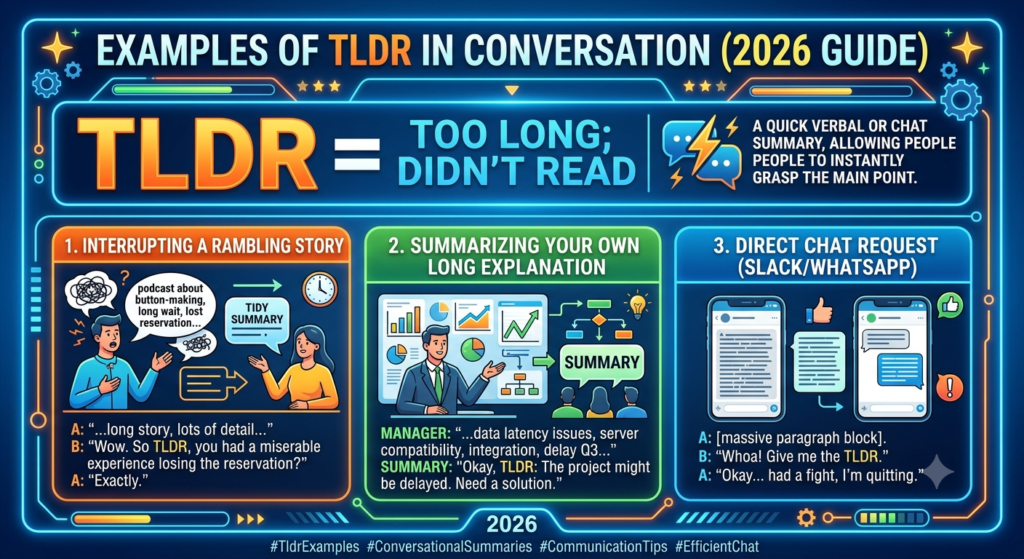
Here’s how TLDR looks in different real-life contexts:
- Texting a friend: “Ugh long story short, TLDR: I’m not going to the party tonight.”
- Reddit post: “TLDR: My coworker took credit for my project and I don’t know how to bring it up to my manager.”
- Work email: “TLDR: The launch is delayed to next Friday — no action needed from your team yet.”
- Asking for one: “That’s a lot, what’s the TLDR?”
- Gaming chat: “TLDR: patch nerfed healers, buffed tanks.”
🕓 When to Use and When Not to Use TLDR
TLDR is a useful tool, but timing and context matter.
✅ When to Use TLDR
- You’ve written a long message and want to respect the reader’s time.
- You’re posting a lengthy story, update, or explanation online.
- You’re summarizing a long email thread for someone catching up.
- You want to signal the key takeaway before someone reads the details.
❌ When Not to Use TLDR
- In formal or professional writing where “In summary” or “Key takeaway” reads more polished.
- As a dismissive reply to something serious, emotional, or sensitive — it can come across as cold.
- When the message is already short; adding TLDR just feels unnecessary.
- In a first message to someone you don’t know well, since the tone can be misread.
🔄 Other Meanings of TLDR in Text
While “Too Long; Didn’t Read” is by far the most common meaning, TLDR can occasionally show up in other contexts:
- TLDR News — a YouTube and Nebula-based news channel known for short, digestible news breakdowns.
- tldr pages — a collaborative, open-source project that gives simplified example-based documentation for command-line tools.
- TLD registrar — in a technical/domain context, “TLD” (without the R) refers to a top-level domain, though this is unrelated slang.
In casual texting, though, TLDR almost always means “too long; didn’t read.”
🔄 Similar Slang Words or Alternatives
If you’re looking for other ways to say the same thing, here are common alternatives people use in text:
| Slang | Meaning |
|---|---|
| In short | Formal way of summarizing |
| Long story short | Casual way to introduce a summary |
| IMO / TBH | Not summaries, but often paired with TLDR for tone |
| Recap | Common in work chats and group updates |
| Short version | Plain-language alternative to TLDR |
| Cliff notes / Cliffs | Slang for a quick summary, popular on Reddit and Discord |
🧾 Why People Use TLDR in Texting
TLDR has stuck around for over two decades because it solves a real problem: too much text, not enough time. Here’s why it’s so widely used.
⚡ Fast
It takes two seconds to type and instantly signals “here’s the short version.”
📱 Convenient
Perfect for mobile conversations where scrolling through paragraphs is annoying.
😎 Casual
It fits naturally into informal texting without sounding stiff or robotic.
🔥 Online Culture
It’s become part of internet vocabulary, especially on Reddit, Discord, and social media captions.
🎨 Flexible
It works for serious updates, funny stories, gaming recaps, and everything in between.
🧠 Is TLDR Friendly or Rude?
This depends entirely on tone and context — TLDR isn’t inherently rude, but it can land the wrong way.
😊 Friendly
When you use TLDR to summarize your own long message, it reads as considerate — you’re saving the other person time.
😐 Neutral
When someone asks “what’s the TLDR?” in a casual group chat, it’s usually just a normal request for a quick summary, not an insult.
😠 Rude or Impatient
When TLDR is used as a dismissive reply to something personal, emotional, or important, it can come across as careless or cold. In that situation, something like “I don’t have time to read this right now, can you give me the short version?” is a gentler way to say the same thing.
❓ frequently asked questions
❓ What does TLDR stand for?
TLDR stands for “Too Long; Didn’t Read,” used to flag or provide a short summary of a longer message.
❓ Is TLDR rude?
Not usually — it depends on context. Using it to summarize your own message is polite; using it dismissively on a serious message can feel rude.
What does TLDR mean in business?
In business or work chats, TLDR is used to highlight the key point or action item at the top of a long email or update.
What does TLDR mean in a relationship?
In personal texting, TLDR is used to summarize a long, emotional, or detailed message — though it should be used carefully with sensitive topics.
What does TLDR mean in email?
In emails, TLDR (or “TL;DR”) sums up the main point at the top so busy readers can skip the details if needed.
What does TLDR mean in tech?
In tech and coding communities, TLDR is used the same way — as a quick summary — often seen above documentation, changelogs, or GitHub readme files.
What does TL;DR mean in ChatGPT?
When used with AI tools, TLDR is often a direct request asking the AI to shorten or summarize a longer piece of text.
TLDR Reddit meaning?
On Reddit, TLDR is standard etiquette at the end of long posts, giving readers a one- or two-line summary before diving into the full story.
What does TLDR mean in gaming?
In gaming chats, TLDR quickly sums up patch notes, strategies, or long discussions so players can get the key info fast.
TLDR example?
“I had a rough day at work, missed my train, and got soaked in the rain. TLDR: today was a mess.”
Final Thoughts
TLDR is one of those internet abbreviations that’s stuck around because it’s genuinely useful. Whether you’re wrapping up a long text to a friend, summarizing a Reddit story, or flagging the key point in a work email, TLDR helps everyone save time without losing the message. Used thoughtfully, it’s less about laziness and more about respecting your reader’s attention.
