You open a chat and see “That pizza was OD good.” Or worse: “Did he OD?” Same two letters, completely different vibes.
So what does OD mean in text? It depends on the sentence. In casual chat, OD usually means “overdoing it,” “too much,” or “extremely.” In a serious or medical context, it means overdose.
This guide explains both meanings, shows real examples, and helps you read the tone correctly so you never reply the wrong way.
🧠 What Does OD Mean in Text?
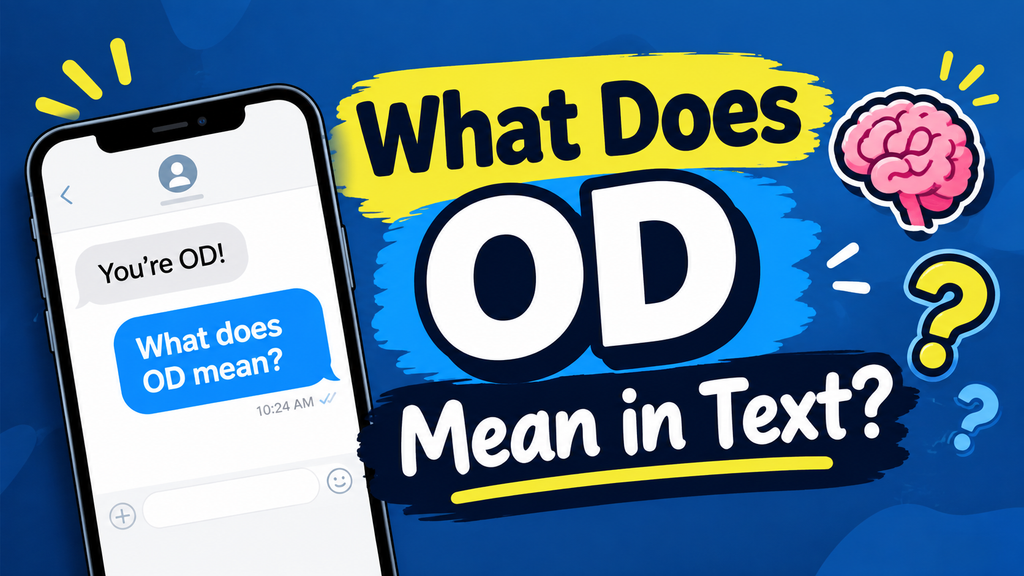
Quick answer: OD in text most often means “too much” or “extremely.” In serious conversations about drugs or medicine, it means “overdose.”
Context decides everything. Look at who is talking, what they are talking about, and which emoji comes with it.
1. OD = Overdose (Literal / Serious Meaning)
This is the original meaning. A drug overdose happens when someone takes far more of a substance than the body can safely handle. People shorten it to “OD” in texts, news posts, and everyday talk.
Examples:
- “I heard he OD’d last weekend.”
- “She’s in the hospital after an OD.”
There are no jokes or emojis here. The tone is heavy, and it should be treated that way.
2. OD = Overdoing / Too Much (Casual Slang Meaning)
In everyday texting, OD works as a shortcut for “overdone” or “over the top.” It is the same idea as saying something went too far.
Examples:
- “Don’t OD on the hot sauce 😂”
- “That’s OD, $40 for fries?”
💡 In Short:
| If you see… | It probably means… |
|---|---|
| “OD good,” “OD funny,” “OD tired” | Extremely good, funny, tired |
| “You’re OD’ing” | You’re going overboard |
| “He OD’d,” “she overdosed” (serious tone) | Drug or medication overdose |
| Standalone “OD.” | “That’s way too much” |
🔥 Different Meanings of OD in Texting
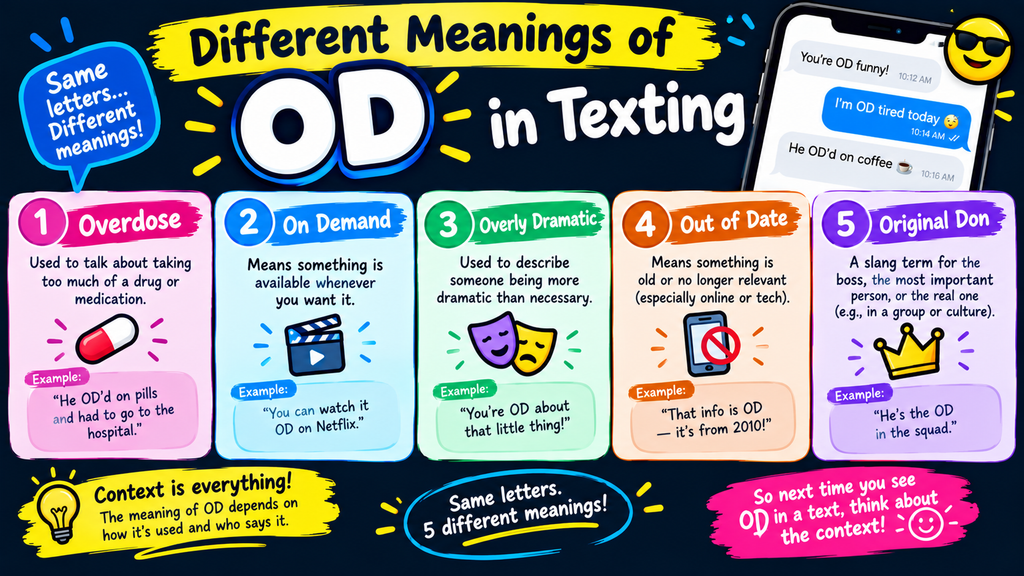
OD wears several hats online. Here are the ones you are most likely to meet.
💊 1. Medical Meaning (Overdose)
This is the heaviest meaning. It refers to taking a dangerous amount of a drug, whether prescription, over-the-counter, or illegal. It shows up in news, health discussions, and serious chats between friends or family.
If someone texts that they or another person may have overdosed, treat it as an emergency. Contact your local emergency number right away.
😂 2. Casual Slang (Overdoing Something)
Here, OD means someone is doing too much of something, usually in a joking way.
- “You OD with the filters on that pic.”
- “We OD’d on snacks before the movie even started.”
The tone is playful, and nobody is in danger.
🔥 3. Expression of Intensity (Gen Z Slang)
This is the most popular use online. OD acts like a booster word, similar to “super,” “so,” or “extremely.” It goes right before an adjective.
- “That fit is OD clean.”
- “This boss fight is OD hard.”
- “She’s OD funny.”
It can be positive or negative. “OD good” is praise, while “OD annoying” is a complaint. Many people trace this usage to New York slang and hip-hop culture, though its exact origin is hard to pin down. Today it is common on TikTok, Instagram, gaming chats, and group texts.
😅 4. Negative Overreaction (Less Common)
Sometimes OD points at someone who is being dramatic or taking things too far.
- “Bro, you’re OD about a late text.”
- “That reaction was OD.”
It is close to saying “chill” or “you’re doing too much.”
🔎 Other Meanings You Might Run Into
Outside of slang, OD can also mean:
- Oculus dexter: “right eye” in eye-care prescriptions
- O.D.: Doctor of Optometry
- On demand: as in streaming or on-demand content
- o.d.: “once daily” in medication instructions
These rarely appear in casual chats, but they explain why context matters.
📱 Where Is OD Commonly Used?
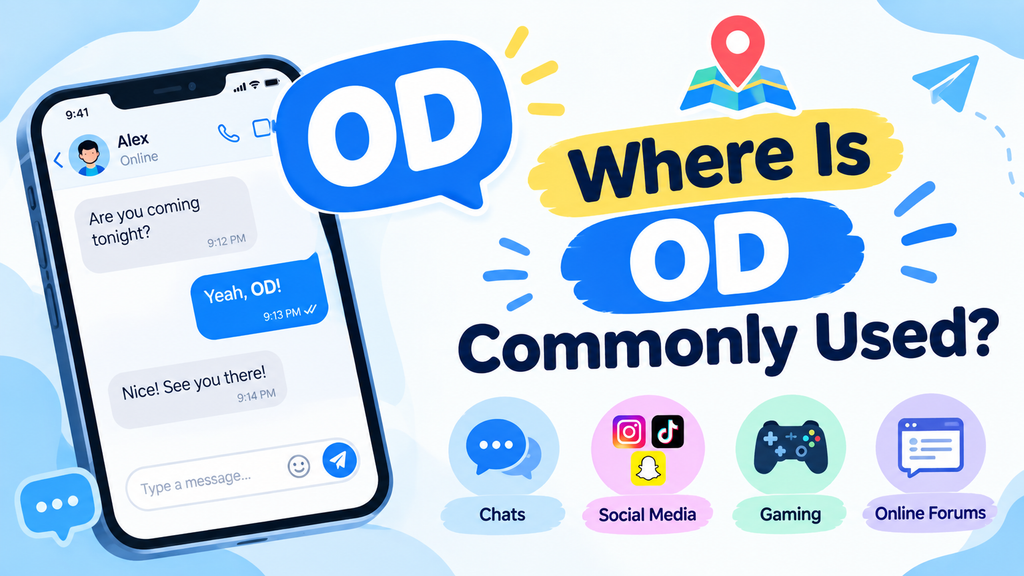
📍 Popular platforms:
- TikTok comments and captions
- Instagram DMs and Stories
- Snapchat and WhatsApp group chats
- X (Twitter) replies
- Gaming chats and Discord servers
🧩 Tone of usage:
- Playful: “That meme is OD funny 😭”
- Hyped: “OD good, you have to try it.”
- Annoyed: “Why is this line OD long?”
- Serious: “He OD’d.” (no emojis, no jokes)
Emojis are a big clue. Laughing or fire emojis point to slang. A plain, quiet sentence about a person’s health points to the serious meaning.
💬 Examples of OD in Conversation
Example 1: Praise
A: Did you see her new video?
B: Yeah, it was OD good 🔥
Example 2: Teasing a friend
A: I bought four phone cases today.
B: Bro you OD’ing 😂
Example 3: Complaining
A: Rent went up again.
B: That’s OD. They can’t be serious.
Example 4: Gaming
A: This level is OD hard.
B: Use the shield, it helps.
Example 5: Serious context
A: Did you hear about Mark?
B: No, what happened?
A: He OD’d. He’s in the hospital.
B: Oh no. Is he okay? I’m so sorry.
Notice how Example 5 has no humor and calls for a caring reply.
🕓 When to Use and When Not to Use OD
✅ When to Use OD
- Texting friends or close peers
- Commenting on social media posts
- Joking about food, outfits, memes, or games
- Adding emphasis in a relaxed chat
❌ When Not to Use OD
- Work emails or school assignments
- Messages to teachers, managers, or clients
- Conversations about health, grief, or addiction, where it can sound careless
- Chats with people who may not know the slang
📊 Context Comparison Table
| Context | What OD Means | Tone | Example |
|---|---|---|---|
| Casual chat | Too much / overdoing | Playful | “You’re OD with the emojis 😂” |
| Compliment | Extremely | Positive | “That song is OD good.” |
| Complaint | Excessive | Annoyed | “This traffic is OD.” |
| Health or news | Overdose | Serious | “He OD’d last night.” |
| Eye-care notes | Right eye | Technical | “OD: -2.00” |
🔄 Similar Slang Words or Alternatives
If OD does not feel right, these work in similar situations:
- Extra: over-the-top behavior (“She’s so extra”)
- Doing too much: trying too hard
- Over the top (OTT): exaggerated or dramatic
- Hella / mad / super: intensifiers for “very”
- Doing the most: going beyond what’s needed
- Lowkey / highkey: subtle or strong emphasis
Difference in a nutshell: “Extra” describes a person’s behavior and usually carries attitude. “OD” can describe anything: a person, a meal, a price, or a feeling.
❓ frequently asked questions,
❓ What does OD mean in texting slang?
In texting slang, OD means “too much,” “overdoing it,” or “extremely.” For example, “OD good” means very good.
❓ Is OD always about drugs?
No. Online, OD usually just means “excessive” or “very.” It refers to an overdose only in serious, health-related conversations.
❓ What does “you OD’ing” mean?
It means “you’re going overboard” or “you’re doing too much.” It is usually a light, joking comment between friends.
❓ Is OD positive or negative?
It can be either. “OD good” is a compliment, while “OD annoying” is a complaint, so the word that follows decides the tone.
❓ Can I use OD in formal writing?
No. OD is slang, and its link to “overdose” can confuse readers, so use words like “extremely” or “excessive” in formal settings.
❓ What is the difference between OD and extra?
“Extra” describes over-the-top behavior and often has attitude. “OD” is more flexible and can describe anything that is too much or very intense.
🧾 Final Thoughts
OD is a small word with a big range. In most texts, it means “too much” or “extremely,” and it is usually used for fun. In serious conversations, it means overdose, and it calls for care and compassion.
Before you reply, check three things: the topic, the tone, and the emojis. That is enough to get it right almost every time.
If you are texting casually, go ahead and say a meal was “OD good.” If the chat turns to someone’s health, set the slang aside and respond with kindness.
