You scroll past a caption that says “best wlw movies of the year.” Or a friend texts, “she gives major wlw energy.” Or a dating bio ends with “wlw 🌈.”
If you’ve wondered what those three letters mean, you’re not alone. WLW stands for “women loving women.” It’s one of the most common LGBTQ+ terms online right now.
This guide covers what WLW means, where people use it, how to use it respectfully, and how it differs from similar words.
🧠 What Does WLW Mean in Text?
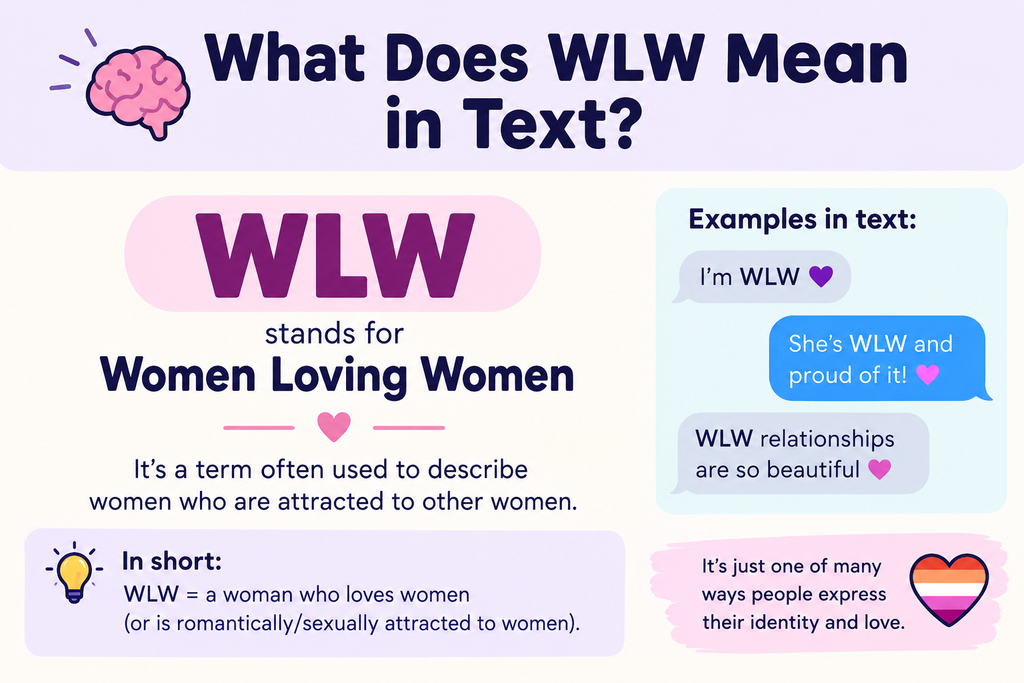
WLW = Women Loving Women.
It describes women who are romantically, emotionally, or physically attracted to other women. You’ll also see it written as “woman-loving woman” or in lowercase as wlw.
Here’s the part many people miss. WLW is an umbrella term. It isn’t limited to one orientation. It can include:
- Lesbian women
- Bisexual women
- Pansexual women
- Queer women
- Other women who are attracted to women
Many glossaries also include nonbinary people who identify with womanhood.
Quick answer: In a text or social media post, WLW means women who love women, or something connected to that experience, like a couple, a story, or a community.
📱 Where Is WLW Commonly Used?
WLW started in community spaces. Now you’ll find it almost everywhere online:
- TikTok: hashtags, video captions, and “wlw check” trends
- Instagram: bios, Reels, and fan pages
- X (Twitter) and Tumblr: fandom talk and relationship posts
- Dating apps: profiles that say “wlw only” or “wlw friends welcome”
- Books and streaming: recommendation lists like “wlw romance reads”
- Fandom communities: labeling ships and characters
- Group chats: casual conversation between friends
It’s mostly an online word. But it has moved into everyday speech too, and some people say it out loud.
💬 Examples of WLW in Conversation
Real examples make the meaning easier to see. Here’s how people use it in messages.
Describing media:
- “This show has such good wlw representation 😭”
- “Any wlw book recs? I just finished a great one.”
Describing a couple:
- “That wlw couple is honestly goals 💕”
- “They’re the cutest wlw pair at school.”
Talking about identity:
- “I’m a wlw looking for something real.”
- “Bio: reader • plant mom • wlw 🌿”
Joking with friends:
- “You gave me total wlw vibes in that outfit lol”
- “Not me finding every wlw playlist on Spotify.”
In all four cases, WLW points to attraction or connection between women.
🕓 When to Use and When Not to Use WLW
WLW is tied to identity, so context matters. A little thought goes a long way.
✅ When to Use WLW
- Describing yourself, if you’re a woman attracted to women
- Talking about media, like a movie, book, or couple that features women in love
- Searching for content, such as “wlw podcasts” or “wlw fanfic”
- Supporting the community, by sharing creators and stories
- Writing a dating bio that signals who you want to meet
❌ When Not to Use WLW
- Labeling someone who hasn’t shared their identity. Don’t guess. Let people name themselves.
- Using it as a joke or a fetish. Reducing WLW to a punchline is disrespectful.
- Using it in formal writing where a full phrase is clearer
- Applying it to men. The term is about women.
- Making assumptions about what it says of someone’s private life
Simple rule: use it for yourself, for things you’re talking about, or for people who’ve told you it fits.
🔄 Other Meanings of WLW in Text
In texting, WLW almost always means “women loving women.” Still, the letters show up elsewhere:
| WLW Meaning | Field | Where You’d See It |
|---|---|---|
| Women Loving Women | LGBTQ+ / social media | Texts, TikTok, dating apps |
| WLW (700 AM) | Radio | A well-known Cincinnati, Ohio station |
| Windows Live Writer | Software | An older blog-publishing tool |
| WLW | Airport code | Willows-Glenn County Airport, California |
| WLW | Rail code | Welwyn North station, England |
| World League Wrestling | Sports entertainment | An independent U.S. wrestling promotion |
If the conversation is about love, identity, or representation, you can be confident it means women loving women.
🔄 Similar Slang Words or Alternatives
WLW is part of a bigger family of terms. Here’s how the main ones compare:
| Term | Meaning | Notes |
|---|---|---|
| WLW | Women loving women | Umbrella term, very common online |
| Sapphic | Women (and often nonbinary people) attracted to women | Named after the poet Sappho; used much like WLW |
| Lesbian | A woman attracted primarily or only to women | One specific identity |
| MLM | Men loving men | The male counterpart |
| NBLW / WLNB | Nonbinary loving women / women loving nonbinary | Newer “gender loving gender” terms |
| SGL | Same gender loving | Coined in the 1990s and used especially in Black communities |
| Queer | Broad term for many sexual and gender identities | Wider than WLW |
| F/F | Female/female | Often used in fiction and fandom tags |
WLW vs. sapphic: They overlap a lot. Some people feel sapphic is a bit more open to nonbinary and gender-expansive folks. Others use them interchangeably.
🧠 Is WLW Friendly or Sensitive?
Mostly friendly. WLW is a positive, affirming word. People use it with pride, and it often feels warm and inclusive.
It can still be sensitive in a few situations:
- Outing someone. Calling a person WLW without their permission can expose something private.
- Fetishizing. Treating WLW relationships as entertainment for others crosses a line.
- Wrong context. Using it carelessly in a serious or professional setting can feel off.
Tone check: Warm, curious, and respectful works every time. Emojis like 💖, 🌈, and 💕 usually signal a friendly tone.
📊 Why Do People Use WLW in Texting?
There are a few clear reasons the term caught on:
- It’s short. Three letters fit easily in a caption, hashtag, or bio.
- It’s inclusive. One word covers lesbian, bi, pan, and queer women without forcing a single label.
- It centers attraction. It describes who you love rather than putting you in a box.
- It builds community. Searching “wlw” helps people find friends, creators, and stories.
- It’s flexible. Use it for people, couples, media, or whole communities.
- It feels affirming. Some people, including many queer people of color, feel it fits their identity better than older labels.
Some sources trace the phrase to Black American communities in the early 20th century. There’s no single confirmed origin, so treat that history as “likely” rather than settled.
❓ Frequently Asked Question
❓ What does WLW stand for in texting?
WLW stands for “women loving women.” It describes women who are romantically or emotionally attracted to other women.
❓ Is WLW the same as lesbian?
Not exactly. Lesbian is one specific identity, while WLW is a broader umbrella that also includes bisexual, pansexual, and queer women.
❓ Is WLW only used online?
No. It started in online and community spaces, but people also say it in everyday conversation, in books, and in media discussions.
❓ Is WLW a respectful term?
Yes, it’s generally positive and affirming. Just use it thoughtfully, and never label someone who hasn’t chosen the word themselves.
❓ Can men be part of WLW?
No, the term describes women’s attraction to women. Men can support, read, and enjoy WLW stories, but they aren’t described by the label.
❓ Why do people use WLW instead of “lesbian”?
WLW is more inclusive. It covers women who aren’t exclusively attracted to women, and some people simply find it more comfortable.
❓ Where do I see WLW most often?
You’ll find it mostly on TikTok, Instagram, Tumblr, X, dating apps, and in book or show recommendations.
🧾 Final Thoughts
WLW means women loving women. It’s a short, inclusive term that covers a wide range of identities, and it has become a normal part of how people talk about love and representation online.
Use it with care, let people define themselves, and keep the tone kind. Whether you’re searching for wlw books, writing a bio, or decoding a friend’s text, you now know exactly what those three letters mean.
